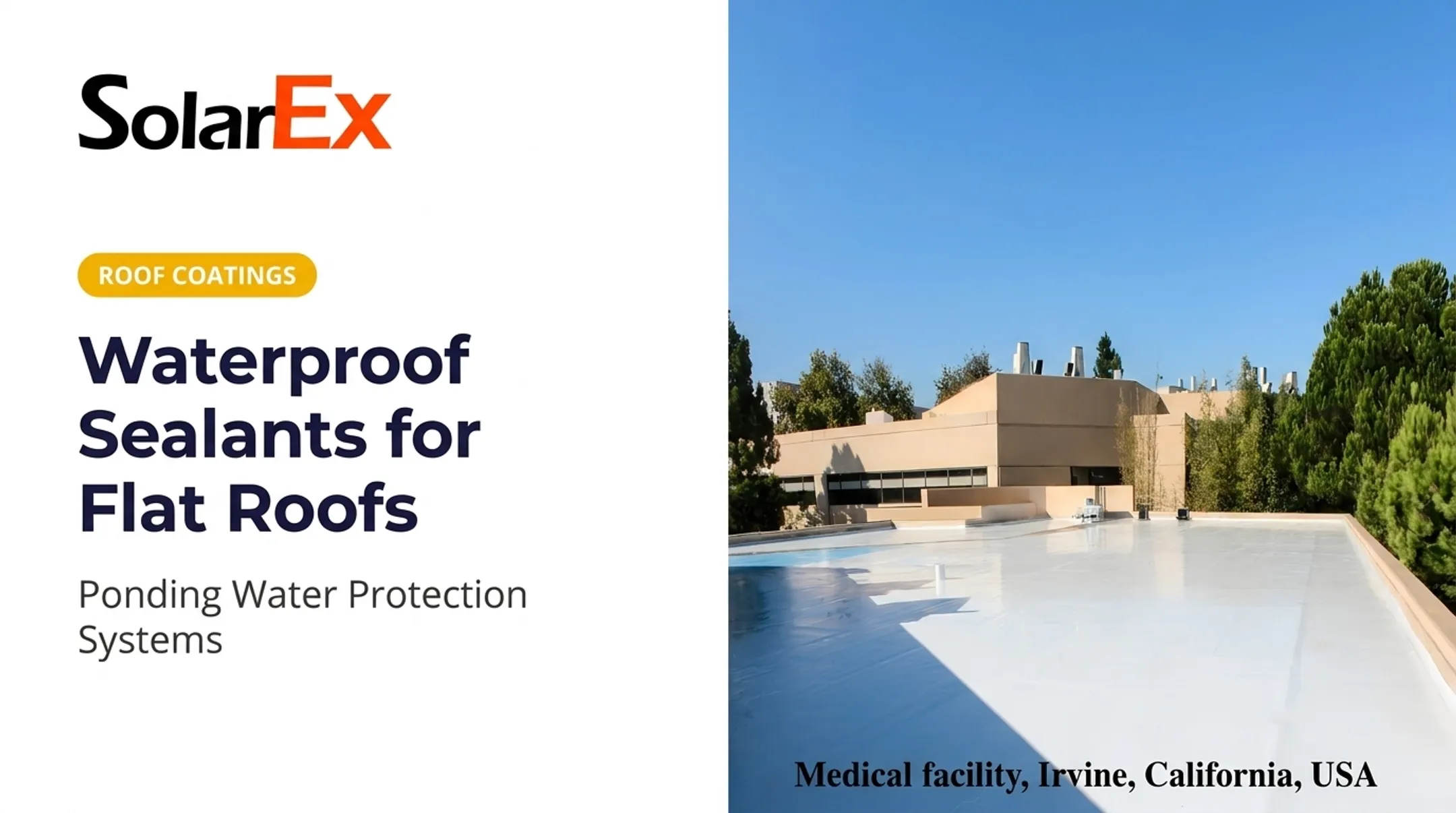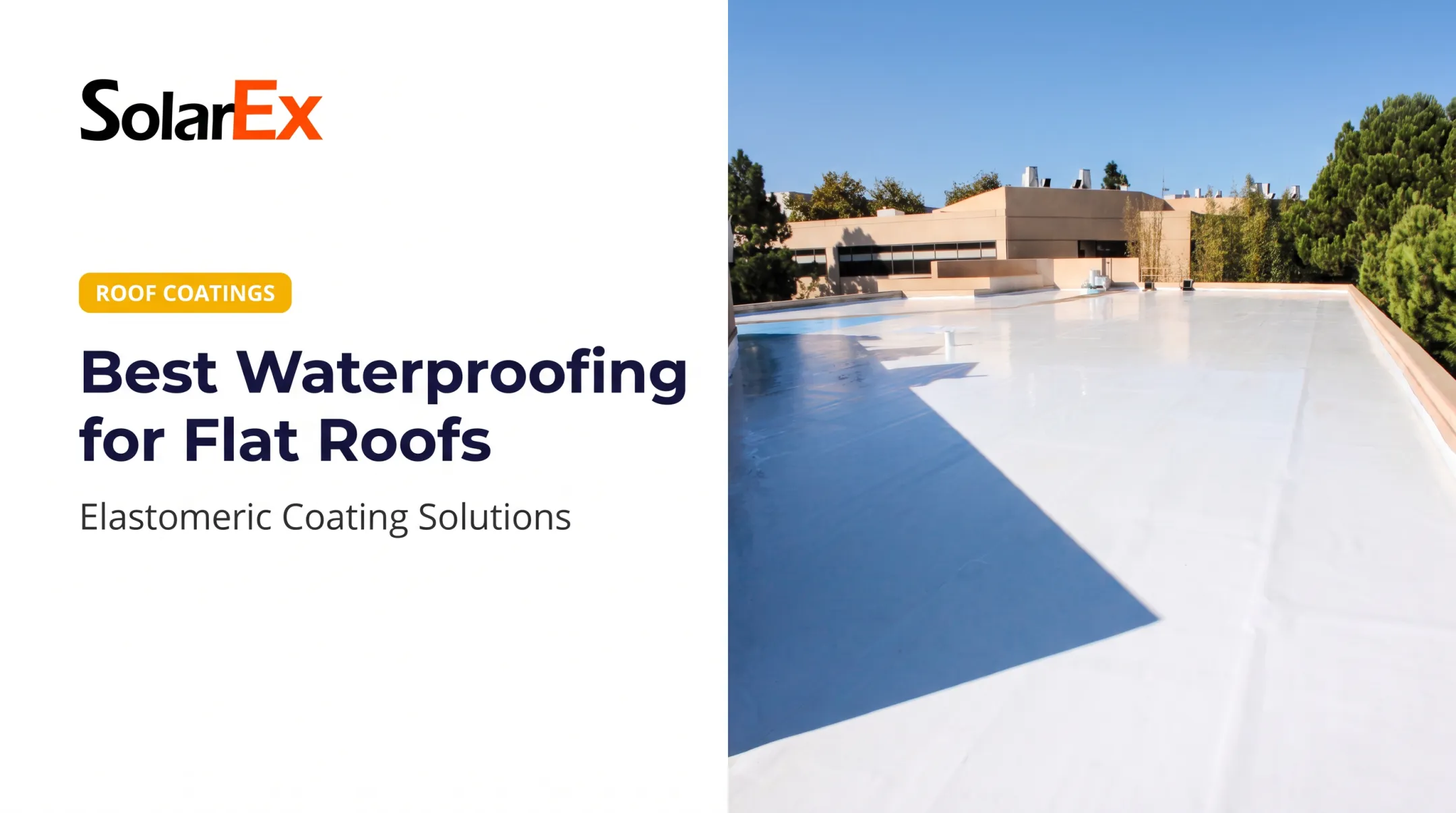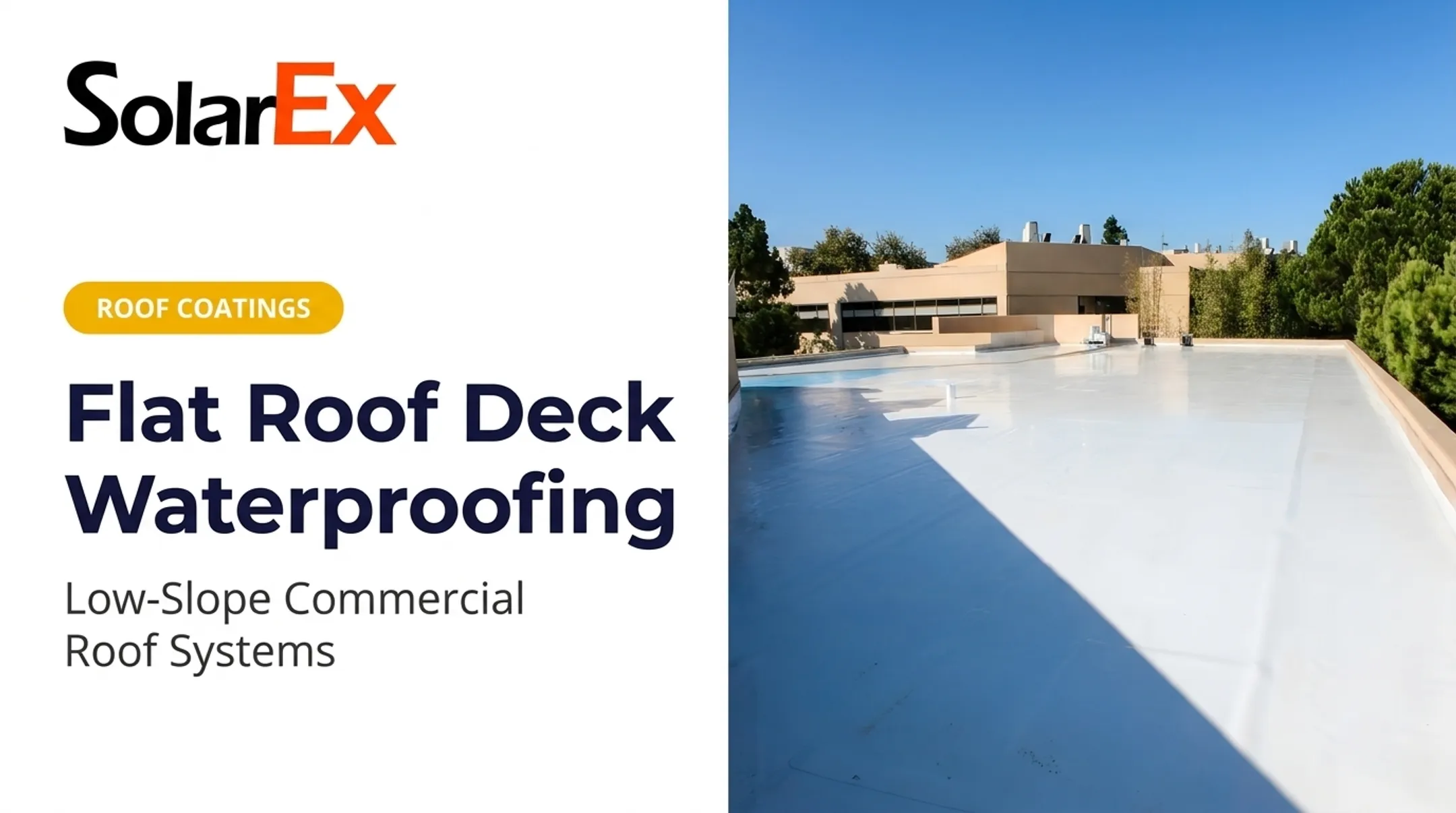

The American Concrete Institute notes that drying shrinkage in concrete produces cracking, which can lead to corrosion at crack locations and freeze-thaw deterioration over time. On a flat roof, those same cracks become water-entry points the moment ponding starts.
So what's the best waterproofing for a flat concrete roof? In most cases, a properly specified liquid-applied membrane or compatible silicone coating works well on a sound concrete deck. But "best" depends on your substrate condition, drainage, movement, foot traffic, and what the manufacturer's tested system actually allows.
This guide compares silicone coatings, other liquid membranes, sheet systems, penetrating sealers, and the point where repair or replacement makes more sense than coating.
Key Takeaways
- A waterproof coating only works as part of a complete system, not a standalone patch or paint job.
- Silicone handles ponding water and UV well when the substrate is compatible and properly prepared.
- Drain condition, seams, cracks, and flashing details matter as much as the coating itself.
- Have exposed reinforcement or structural damage professionally fixed before any coating goes down.
- Compare warranty terms and lifecycle cost, not just the price per gallon.
Overview of Waterproofing for Flat Concrete Roofs in the US
Waterproofing a flat concrete roof means combining coatings, membranes, sealers, and drainage corrections to keep water out of the roof assembly. No single product carries the full load alone.

Concrete looks solid, but it's porous. It can absorb moisture through capillary action, and construction joints, control joints, and shrinkage cracks all create potential paths for water. Concrete is not automatically watertight, no matter how well it was poured.
Where Flat Concrete Roofs Actually Fail
Before choosing any waterproofing system, walk the roof and check these areas:
- Ponding water that sits for more than 48 hours after rain
- Drains that are undersized, clogged, or poorly located
- Cracks at slabs, construction joints, and parapet walls
- Penetrations for pipes, HVAC units, and roof-mounted equipment
- Flashing transitions at parapets, curbs, and roof edges
- Blistering or peeling in any existing coating
According to the National Roofing Contractors Association, wet insulation and wet decks in cold climates are susceptible to freeze-thaw cycles that cause spalling in cementitious materials. That's a slow-moving problem — by the time you see surface damage, moisture may already be trapped underneath.
The "best" waterproofing choice comes down to your priorities:
- Maximum resistance to ponding water
- Easy detailing around multiple roof penetrations
- Low-VOC application while the building stays occupied
- Traffic tolerance for maintenance crews
Each priority points toward a different system.
Best Waterproofing Systems for Flat Concrete Roofs
Every option below gets judged against the same criteria: compatibility with concrete, ponding and UV resistance, crack-bridging ability, movement tolerance, installation complexity, and total lifecycle value, not just sticker price.
SolarEx Silicone Cool Roof Coating
SolarEx's SiliconEx 500 is a 100% silicone, solvent-free, single-component, moisture-cured coating that forms an elastic, monolithic membrane directly over concrete. It's built for restoration projects where the goal is protection and energy efficiency, not a full tear-off.
Key performance details to verify against current technical documentation:
- Designed for permanent ponding-water resistance after full cure
- Rated for severe weathering, freeze-thaw cycles, and thermal shock
- Low-VOC formulation (under 50 g/L in high-solids testing)
- 250% ± 15% elongation and 94% ± 2% total solids by weight
- No degradation reported after 5,000 hours of QUV weathering testing
Before application, concrete moisture content should generally sit below 5%, and an adhesion test determines whether a primer is needed. Seal all joints, cracks, and penetrations first with SealEx 510 mastic or SealEx tape.
Coverage scales with warranty length: roughly 1.5 gallons per 100 sq. ft. for a 10-year system, 2.0 gallons for 15 years, and 2.5 gallons for 20 years. Material cost typically runs $1.25 to $1.64 per square foot for the 20-year system. Labor and repairs are quoted separately.

Application must happen by roller, brush, or airless spray, with surface temperatures above 55°F and no rain forecast within 48 hours. Cure time runs 10-12 hours at 75°F and 50% relative humidity.
Reflective coatings like this one also reduce heat absorption, which can complement rooftop solar arrays. Actual energy savings depend on your building, climate, and system size.
Liquid-Applied Elastomeric Membrane Systems
Liquid membranes create a continuous, seamless layer that flows around penetrations, curbs, and irregular geometry. Those details are tough to cover cleanly with rigid sheet materials.
Three chemistries dominate this category:
- Silicone: strong ponding-water and UV resistance, moisture-cured
- Acrylic: water-based, cost-effective, but generally less tolerant of standing water
- Polyurethane: high abrasion and impact resistance, good for roofs with regular foot traffic
Industry ASTM specifications (D6694 for silicone, D6083 for acrylic, D6947 for polyurethane) define testing categories like elongation, tensile strength, and weathering resistance. They don't guarantee identical performance across every branded product, though. That's what the manufacturer's data sheet is for.
A seamless finish is not a shortcut around prep work. Cracks still need repair. Joints still need reinforcement. Drains, parapets, and penetrations still need detailing before the field coat ever goes on. Skip that step and even the best chemistry will fail early.
Sheet Membranes: PVC, TPO, or Modified Bitumen
Pre-formed sheet membranes make sense when a project calls for a manufactured system with documented seams and high puncture resistance. They're often specified for larger commercial buildings.
Installing sheet membranes over concrete comes with its own requirements:
- Deck prep: smooth, structural concrete free of sharp ridges, with cracks wider than 1/8 inch repaired
- Dryness check: the deck must be dry and cured (typically 28 days) before installation
- Seam welding: hot-air welded seams need a minimum 1½-inch weld width, verified with test welds
- Wind uplift design: fastening rates follow standards like ANSI/SPRI WD-1, adjusted for local code and wind exposure
Compared to liquid coatings, sheet systems handle simple, large, flat fields well but create more seams to maintain around complex detailing. Liquid systems flow around irregular geometry more easily but depend entirely on substrate prep and adhesion. Neither format wins universally. The right choice depends on the roof's shape and how much detailing it requires.
Penetrating Concrete Sealers and Cementitious Waterproofing
Penetrating sealers (silane, siloxane, silane/siloxane blends) soak into concrete pores and create a hydrophobic barrier that causes water to bead on the surface. They reduce moisture absorption. They do not seal a roof.
These products work best on:
- Sound concrete that needs added protection, not active repair
- Static, non-moving cracks like stabilized shrinkage cracks
- Supporting a broader waterproofing assembly, not replacing one
Cementitious and crystalline waterproofing materials can stop minor leaks and tolerate small movement at crack locations, but they're not a substitute for a flexible, traffic-rated membrane. If you're dealing with active leaks, standing water, or moving joints, neither a penetrating sealer nor a cementitious coating alone will solve the problem. You need a flexible membrane system engineered for those conditions.
Repair, Drainage Correction, or Roof Replacement
No coating should ever cover up structural problems. That includes exposed or corroded reinforcement, major displacement cracks, saturated insulation, and drainage systems that simply can't keep up.
Before waterproofing anything, address these first:
- Concrete repair and crack injection for movement joints
- Drain correction if water regularly sits for more than 48 hours
- Removal of failed or delaminating existing coatings
- A professional moisture assessment if wet insulation is suspected
SolarEx's own warranty terms exclude damage from structural defects or physical substrate movement. That exclusion is a clear signal that coatings are a restoration tool, not a structural fix. If the substrate can't provide a stable, clean, adequately draining base, replacement or major restoration is the more honest answer.
How We Chose the Best Waterproofing for a Flat Concrete Roof
We ranked options on documented technical performance and installation requirements—not marketing claims or low upfront price. A coating only earns a spot if it can hold up on a real flat concrete roof under ponding, movement, and UV.
Before ranking any option, assess the roof itself:
- Age and original construction method
- Current concrete condition and moisture content
- Existing coating (if any) and its adhesion
- Crack pattern, drainage layout, and ponding duration
- Penetrations, parapets, and roof access for maintenance
Moisture is the variable most people skip. The ASTM D4263 test method exists specifically because capillary moisture in concrete can compromise coating systems that aren't designed to tolerate it. Testing before coating isn't optional. Skip it, and a system built for 20 years can fail early.
Common Mistakes That Void Warranties
Even a strong product fails when the substrate or detailing is wrong. These errors show up constantly in warranty disputes:
- Applying coating over damp or contaminated concrete
- Skipping movement-joint repair before the field coat
- Ignoring water trapped below the surface, assuming the top layer will "breathe" it out
- Mixing incompatible products from different manufacturers
- Relying on spot patches instead of full-roof detailing
- Treating a reflective finish as waterproofing on its own
Drainage deserves its own callout. NRCA defines positive drainage as a design that clears ponding within 48 hours under normal drying conditions — a coating cannot create that geometry on its own. If your roof holds water longer than that, fix the slope or drainage first.
**Our decision rule: use a coating on a sound, repairable roof when restoration fits the budget and condition. Specify a sheet membrane when the job needs a documented seam assembly. Remediate or replace when the roof base itself is unstable.

Conclusion
The best waterproofing for a flat concrete roof is the complete, compatible system that addresses your roof's actual failure points — not the cheapest coating on the shelf or the one with the loudest marketing.
Preparation matters as much as product choice:
- Drainage correction before coating
- Crack and joint treatment
- Detail reinforcement at every penetration
- Correct application thickness
- Ongoing inspection after installation
Compare documented performance data and warranty conditions before committing to any system. If you're seeing exposed reinforcement, persistent leaks, or signs of structural movement, get a qualified roofing professional to assess the roof before applying anything.
If you're weighing an integrated cool-roof and solar-ready approach for a flat concrete roof, SolarEx can walk through product specifications and project details. Reach the team at +1 (877) 888-2278 or info@solarexsys.com.
Frequently Asked Questions
What is the best waterproofing for a concrete flat roof?
It depends on roof condition, drainage, and movement. A properly specified liquid-applied membrane or compatible silicone system often suits a sound roof, while severe deterioration usually calls for repair or replacement first.
Is silicone coating good for a flat concrete roof?
Silicone offers strong ponding water and UV resistance when the substrate is compatible and properly prepared. Success depends on moisture testing, crack sealing, correct application thickness, and following the manufacturer's specifications exactly.
How do you prepare a concrete roof before waterproofing?
Preparation includes cleaning, removing loose material, checking moisture content, repairing cracks and joints, inspecting drains, and priming where specified. Penetrations and transitions need reinforcement before any coating goes on.
Can waterproofing fix ponding water on a flat concrete roof?
A ponding-resistant coating protects the surface but doesn't correct inadequate drainage or major low spots. Assess drain placement, slope, and roof assembly design before assuming a coating alone will solve the problem.
Is a roof coating better than a sheet membrane for concrete?
Roof geometry and detail complexity drive the choice. Coatings handle irregular shapes and penetrations more easily; sheet membranes suit large, simple fields where documented seams and puncture resistance are priorities.
When should a flat concrete roof be replaced instead of coated?
Replacement makes more sense when you see structural deterioration, exposed or corroded reinforcement, widespread cracking, or saturated insulation. Repeated coating failure or drainage that can't be corrected are also red flags worth a professional evaluation.