
Introduction
Buildings move. Concrete slabs expand in summer heat and contract in winter cold. Wood swells with humidity. Roof seams flex under foot traffic and wind uplift.
Every gap, joint, seam, and crack in a structure experiences some degree of movement, and rigid fillers simply can't keep up.
That's where elastomeric sealants come in. These are flexible, rubber-like materials engineered to stretch, compress, and rebound while maintaining a continuous seal against water, air, and dust.
This guide breaks down how elastomeric sealants work, where contractors and building owners actually use them, how they stack up against silicone and standard caulk, and what to check before you apply one.
Key Takeaways
- Elastomeric sealant is a performance category; chemistry varies widely by manufacturer.
- Choose products by flexibility, adhesion, weather resistance, paintability, and substrate compatibility.
- A joint sealant and a broad-area elastomeric roof coating solve different problems; don't swap one for the other.
- Always follow the product's technical data sheet for prep, joint dimensions, cure time, and substrate approval.
What Is Elastomeric Sealant?
An elastomeric sealant is a viscous liquid or paste that cures into a pliable rubber. Once cured, it stretches and compresses as adjoining materials shift, closing the gap without cracking loose.
The Sealant, Waterproofing & Restoration Institute describes liquid sealants as materials placed between building components that block air, liquids, and gases while curing into an elastomeric rubber that can accommodate movement (SWRI, Liquid Sealants: Types and Uses).
That role differs from a rigid filler, adhesive, or mechanical gasket. Sealants aren't meant to bear structural loads—they close a gap, keep contaminants out, and allow controlled movement.
Chemistry Isn't One-Size-Fits-All
"Elastomeric" describes a performance trait, not a single ingredient list. SWRI separates organic sealant families—urethanes, acrylics, butyls, polysulfides, and copolymers—from inorganic silicone-resin sealants. Manufacturer literature also adds hybrids such as silyl-terminated polyurethanes.
Don't assume every elastomeric product behaves the same way. Check the chemistry on the technical data sheet before you compare options.
What to Evaluate Before You Buy
Look past the word "elastomeric" on the label. Match the product to the joint with these factors:
- Movement capability — percent of joint width the sealant can handle
- Adhesion — bond strength on your specific substrate
- Tensile and tear strength — resistance to pull and puncture
- Weathering and UV resistance — outdoor durability
- Chemical resistance — where oils, solvents, or cleaners are present
- Cure method — moisture-cure, solvent-release, or two-component mix
- Paintability — whether coatings can go over the cured sealant
ASTM C920 is the governing spec for cured, cold-applied elastomeric joint sealants in building and deck work. It sorts products by type (single- or multicomponent), grade (pourable or non-sag), and movement class—12.5%, 25%, 35%, or 50%—so you can match tested capacity to real joint movement (ASTM C920-18).

Joint Design Matters as Much as the Product
Even a strong sealant fails in a poorly designed joint. SWRI recommends a 2:1 width-to-depth ratio and a backer rod about 25% wider than the joint opening.
Backer rod or bond-breaker tape prevents three-sided adhesion—bonding to both sides and the joint bottom. That third bond restricts movement and tears the sealant during expansion cycles.
Benefits and Limitations
Elastomeric sealants keep moving joints watertight—the job most rigid caulks fail at once substrates shift.
Core benefits:
- Accommodate joint movement from temperature swings, structural settling, or vibration
- Resist water intrusion at vulnerable transitions and penetrations
- Bond to common substrates including concrete, masonry, metal, and wood
- Stay flexible after cure so the seal holds through repeated expansion and contraction
- Seal recurring cracks and perimeter gaps before moisture reaches the structure
That said, no sealant works everywhere. Performance depends heavily on:
- Substrate preparation — dust, oils, or laitance ruin adhesion regardless of product quality
- Joint geometry — wrong depth or missing backer rod causes premature failure
- Cure conditions — temperature and humidity affect skin time and final cure
- Exposure type — UV, chemicals, and immersion each demand different formulations
Those application factors explain most field failures. A few conditions still need extra verification before you seal:
- Permanent water immersion
- Oil or solvent exposure
- Very high service temperatures
- Food-contact surfaces
- Structural bonding (not just weather sealing)
- Joints with unusually high cyclic movement
Check the technical data sheet and safety documentation for VOC limits, primer requirements, ventilation needs, and warranty conditions before starting.
Where Elastomeric Sealants Are Used
Elastomeric sealants show up anywhere two building materials meet and move independently.
Building Envelope Applications
Common uses include:
- Window and door perimeters
- Expansion and control joints in concrete and masonry
- Cracks in concrete or CMU walls
- Facade transitions between dissimilar materials
- Flashing details and wall penetrations
- Glazing beads (toe, heel, cap, and weather beads)
Roofing-Specific Uses
On roofs, sealant work concentrates on localized details rather than the entire field:
- Seams and edge terminations
- Fastener heads and penetrations
- Curbs, pitch pans, and counterflashing troughs
The sealant needs approval for the specific roof membrane and exposure conditions. A product rated for asphalt shingles isn't automatically appropriate for a single-ply membrane.
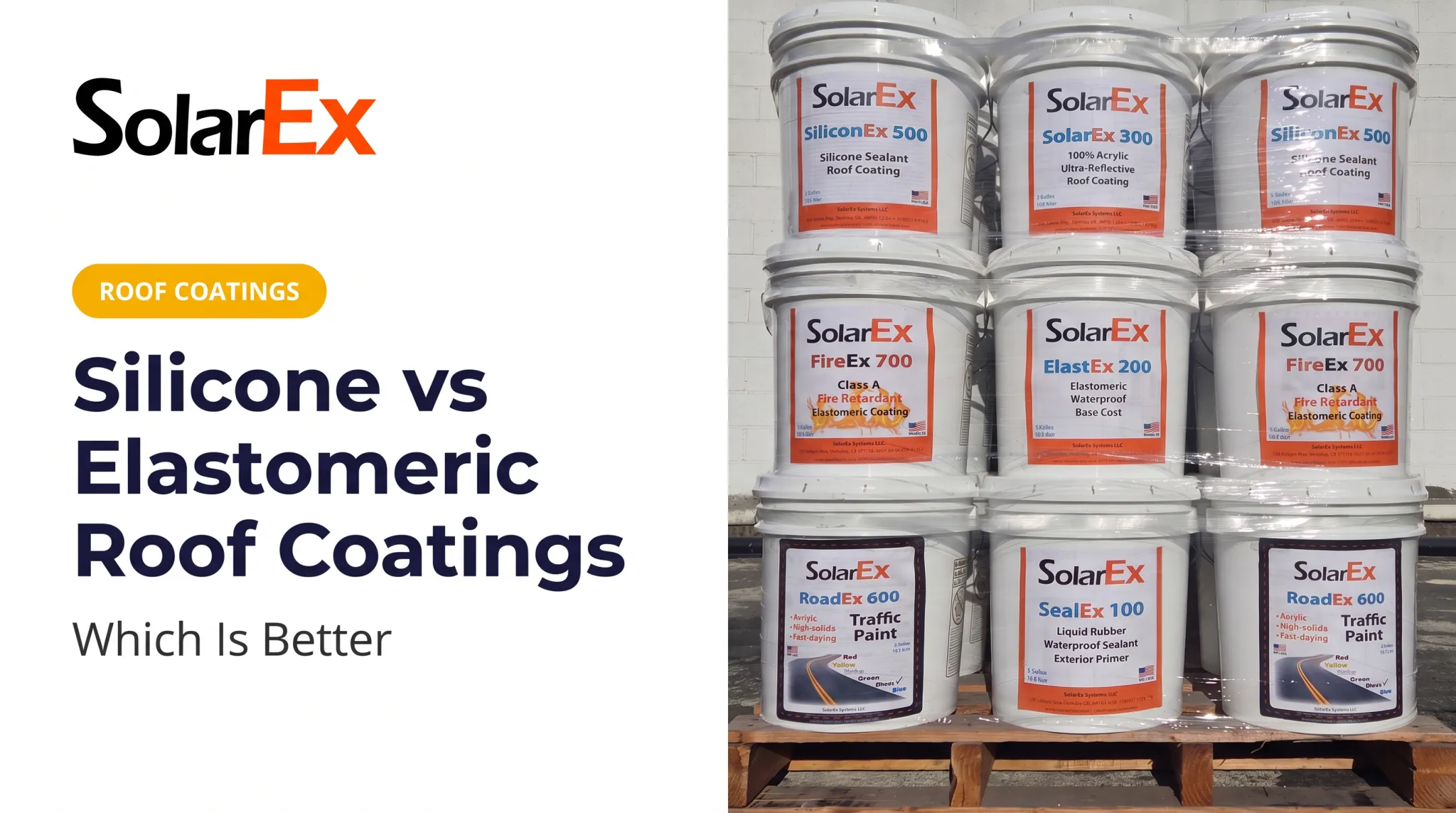
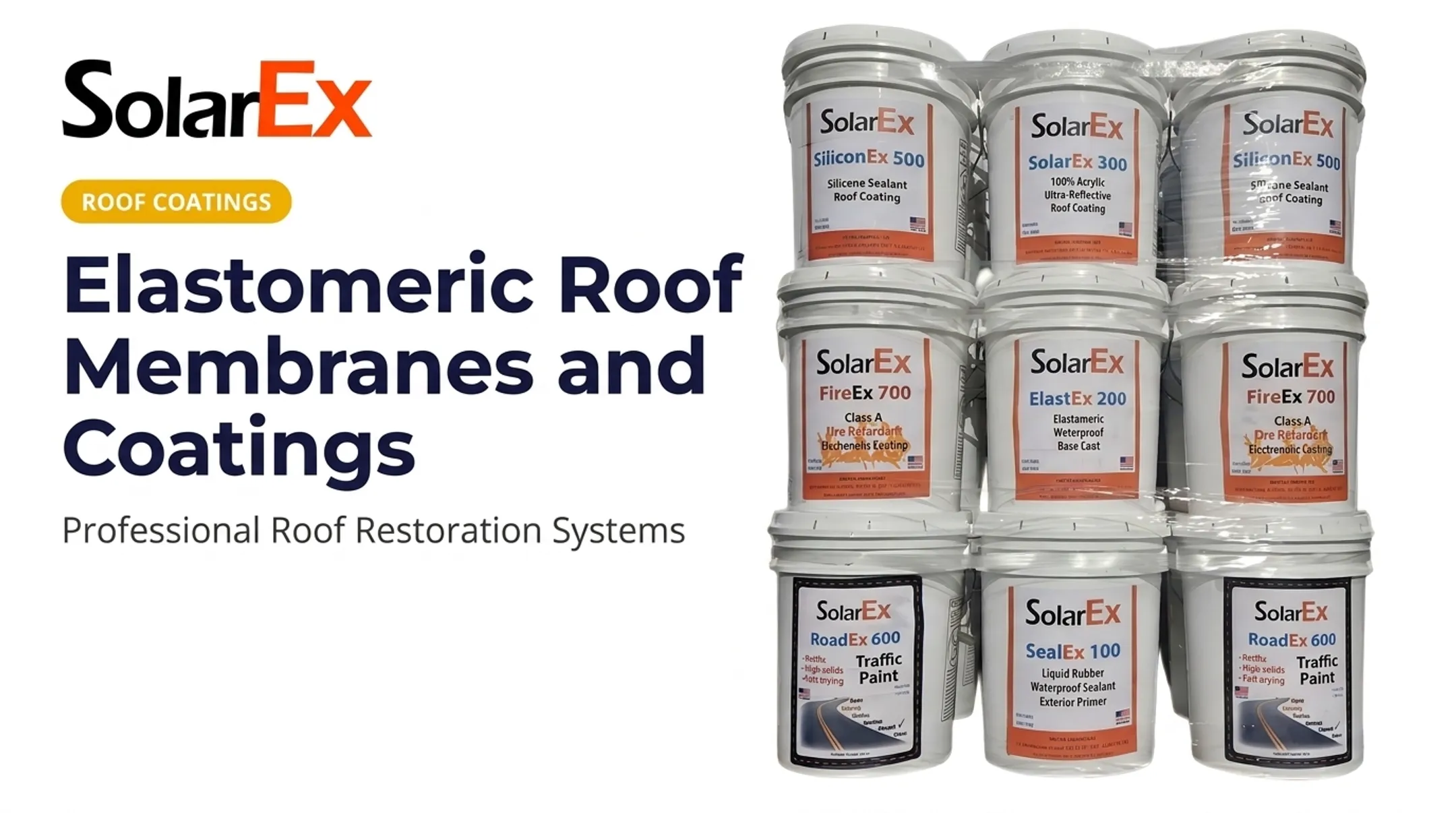
SealEx 100, SolarEx's liquid rubber waterproof sealant, is built for exactly this kind of targeted detail work. It applies over concrete, metal, wood, and asphalt, delivers 500% elongation, and cures into a flexible membrane designed to resist cracking at seams and flashings.
Residential vs. Commercial Context
Homeowners typically use sealant for exterior openings and minor weatherproofing touch-ups. Contractors and facility teams apply it as part of planned joint maintenance or as a step within larger roof-restoration work.
That distinction matters: sealing a seam or penetration is different from coating an entire roof field. SolarEx's SiliconEx 500 silicone coating is designed for broad-area reflective roof restoration. It reflects up to 88% of solar radiation and reduces roof surface temperature.

Localized elastomeric sealant work at joints and penetrations complements that kind of coating system but doesn't replace it. Always verify compatibility between the sealant and the coating manufacturer's documentation before combining the two.
Compatibility isn't the only pre-check. Adhesion varies across concrete, masonry, metal, wood, glass, and plastics, so run a small adhesion test on the actual substrate before committing to full application.
Elastomeric Sealant vs. Silicone, Caulk, and Roof Coatings
These terms get used loosely on job sites, which causes confusion when it's time to buy the right product.
Is "Caulk" Just a Casual Word for Sealant?
Mostly, yes. Industry sources including IIBEC treat caulk and sealant as the same functional category: both fill and seal gaps. "Elastomeric sealant" tends to signal a stronger emphasis on movement capability and long-term flexibility, while "caulk" is often used more generically for lower-movement, cosmetic gap-filling.
Silicone vs. Elastomeric: Not the Same Thing
Silicone is a specific polymer chemistry. It can be elastomeric, but not every elastomeric sealant is silicone. SWRI places silicone in a separate inorganic category from organic urethane, acrylic, butyl, and polysulfide chemistries.
SolarEx Silicone Roof Coating uses 100% silicone chemistry with a moisture-cure process and forms an aggressive chemical bond to the substrate. It holds reflectivity as it ages and resists permanent ponding water, a weak point for many acrylic-based elastomeric coatings under continuous standing water.
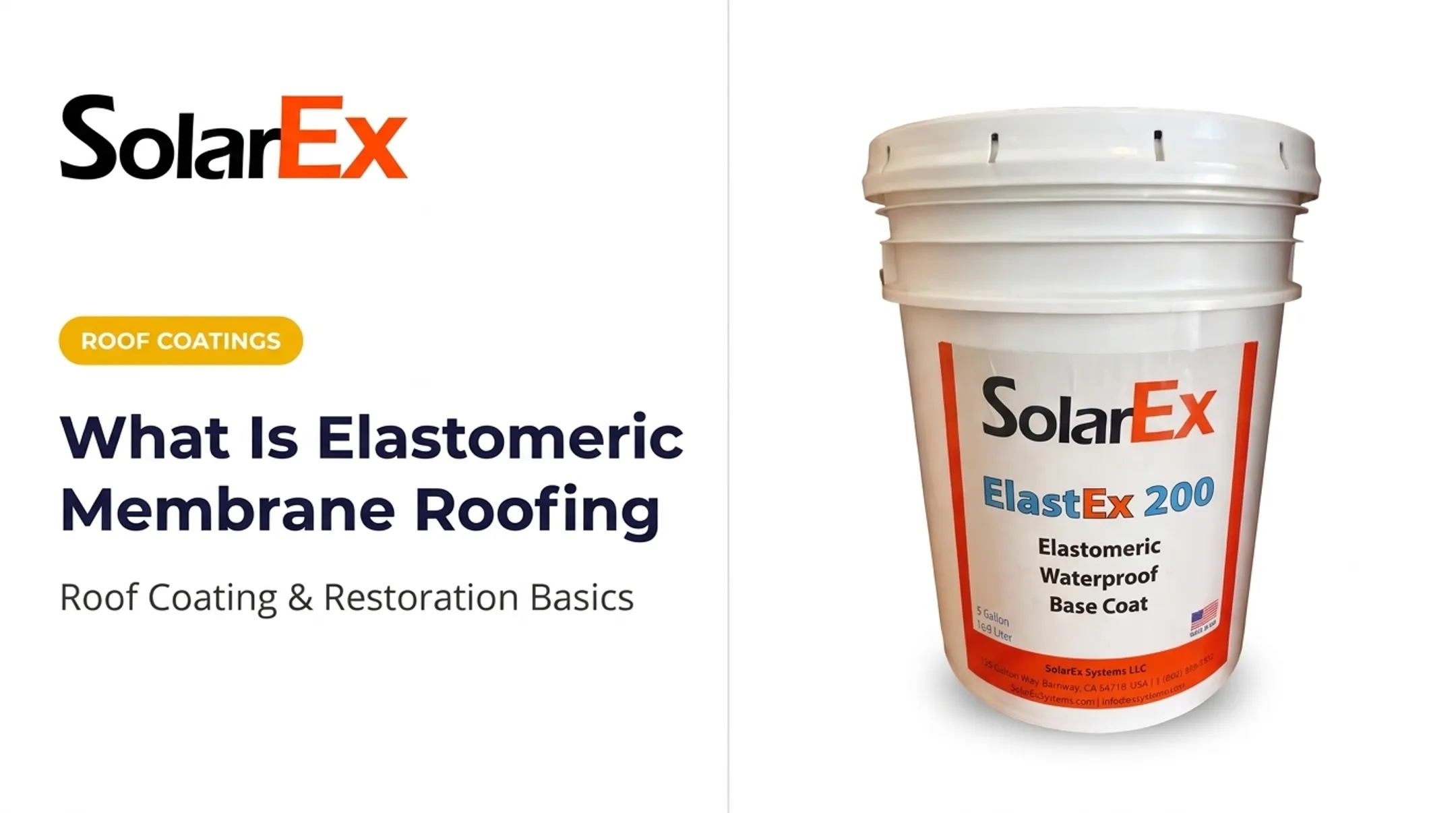
ElastEx 200, by contrast, is a flexible waterproofing membrane built for coastal, humid, and high-alkaline conditions. Its elongation and tensile strength are designed to handle maintenance traffic.
Acrylic and Latex Caulks: Where They Fit
Acrylic and latex caulks generally offer lower movement capability than polyurethane or silicone products. They're easier to paint and fit interior or low-movement exterior joints, but they fall short where joints cycle or stay wet.
Joint Sealant ≠ Roof Coating
This distinction trips people up constantly. A joint sealant targets specific gaps and details. An elastomeric roof coating forms a continuous membrane across a much larger roof area. ASTM D6083/D6083M covers water-dispersed acrylic latex protective roof coatings applied by brush, roller, or spray across the roof surface. That scope is completely different from ASTM C920's joint-sealant specification.
Quick decision guide: pick the product from the job conditions, not the label alone:
- Expected joint or membrane movement
- Substrate type
- Water exposure (including ponding)
- UV conditions
- Paint requirements
- Application area (joint detail vs. full roof field)
How to Choose and Apply Elastomeric Sealant
Selection Checklist
Before opening a cartridge, confirm:
- Substrate material and condition
- Joint type and expected movement range
- Interior or exterior exposure
- Temperature range during and after application
- Moisture and chemical exposure
- Color and paint requirements
- Application method (gun, trowel, spray)
Preparation Steps
- Remove failed sealant and contaminants completely — don't apply new material over old, degraded sealant.
- Clean and dry the joint, eliminating dust, oils, and loose debris.
- Apply primer only when the technical data sheet calls for it. Unnecessary primer can cause its own compatibility issues.
When the elastomeric product is a fluid-applied roof coating rather than a joint bead, surface prep scales up. A 2,500–3,000 psi high-pressure wash is standard before fluid-applied work.
Oil, grease, and animal fat residue need a trisodium phosphate wash followed by a clean-water rinse. Algae growth requires a bleach treatment.
Joint Prep and Application
Install backer rod or bond-breaker material where specified to maintain proper depth and prevent three-sided adhesion. Then:
- Cut the nozzle to match the required bead size.
- Apply with consistent pressure, filling the joint without trapping air pockets.
- Tool the bead per the manufacturer's instructions to improve substrate contact.
SealEx 100 applies by brush, roller, or airless sprayer rated for heavy-bodied elastomeric coatings. Spray equipment needs a pump rated at least 3,000 PSI with a reversible 0.025–0.031-inch tip.
Curing and Protection
Temperature, humidity, and ventilation all affect cure time. Under normal conditions of 70°F with low humidity, SealEx 100 skins over in 4–6 hours and reaches full cure in 24 hours. Cooler or more humid conditions extend that window.

Protect fresh sealant from rain, dust, and foot traffic until it's fully cured.
Service life isn't a fixed number. ASTM's guide for joint sealant application notes that service life depends on polymer type, formulation, substrate compatibility, installation quality, joint design, and ongoing maintenance (ASTM C1193). Check the manufacturer's tested warranty data rather than relying on a generic estimate.
Inspection and Maintenance
Watch existing sealant for:
- Cracking or gaps
- Debonding
- Bubbling
- Shrinkage
Find the cause before recoating. Wrong product, poor prep, or excessive joint movement will defeat a fresh layer if you seal over the same failure mode.
Frequently Asked Questions
What is elastomeric sealant used for?
It seals moving joints, cracks, gaps, seams, and penetrations against water and air intrusion. Common uses include window perimeters, expansion joints, masonry cracks, and roof flashing details.
What is the difference between silicone and elastomeric?
Silicone is a specific sealant chemistry; elastomeric describes flexible, rubber-like performance in general. Silicone products can be elastomeric, but the two terms aren't interchangeable.
Is elastomeric sealant the same as caulk?
Caulk is a broad, everyday term for gap-filling materials. Elastomeric sealant is a flexible performance category; properties still vary by formulation.
Can elastomeric sealant be painted?
Many acrylic, polyurethane, and hybrid sealants are paintable, while most silicone products are not. Always check the product label and overcoat window before painting.
How long does elastomeric sealant last?
Service life depends on chemistry, joint movement, substrate prep, exposure, and maintenance. Check the manufacturer's tested service life or warranty for the product you choose.