
Many owners face the same tangled decision: an aging roof that may or may not be leaking, a cooling system working overtime, and three competing options on the table — a coating, a full replacement, or a solar installation. Choosing wrong wastes money and time.
This guide breaks down cool roof system types, what they actually deliver, where they fall short, cost drivers, installation basics, ratings that matter, and how solar panels fit into the picture. All of it is scoped for U.S. properties and current roofing standards.
Key Takeaways
- A cool roof combines high solar reflectance with strong thermal emittance to limit heat gain.
- Coatings, membranes, metal, and vegetative systems all reduce heat differently — climate, slope, and drainage decide which fits.
- Structural damage, poor insulation, and undiagnosed leaks still need separate repairs.
- Total cost swings with roof size, prep work, material choice, access, and whether it's a retrofit or full replacement.
- Compare ratings, warranty terms, and installation specs before signing anything.
What Is a Cool Roof System and How Does It Work?
Two properties define a cool roof:
- Solar reflectance (SR) — scored 0 to 1; how much sunlight bounces off the surface instead of soaking in
- Thermal emittance (TE) — scored 0 to 1; how efficiently the roof releases heat it does absorb, rather than holding it and passing it into the building
A roof with high SR and low TE can still run hot. When both scores are high, the surface stays coolest in direct sun. Those values roll into a Solar Reflectance Index (SRI), which makes product comparisons easier.
Cool Color Doesn't Mean White
SR and TE also explain why cool roofs are not limited to bright white. About half of sunlight arrives as near-infrared energy, which the eye cannot see. According to Lawrence Berkeley National Laboratory's Cool Roof Q&A, specially formulated dark and medium "cool color" pigments can reflect substantially more near-infrared energy than standard dark colors — sometimes raising SR by roughly 0.4 over a conventional dark surface. HOA-restricted neighborhoods and design-sensitive commercial projects can meet reflectance goals without defaulting to white.
A Product Isn't a System
A reflective coating or membrane is just one layer. A complete cool roof system includes:
- The existing deck or membrane and its current condition
- Insulation and drainage paths
- Flashing and penetration details
- Surface prep, primer, and the coating or membrane itself
- Protective detailing at seams, curbs, and transitions
Initial vs. Aged Performance
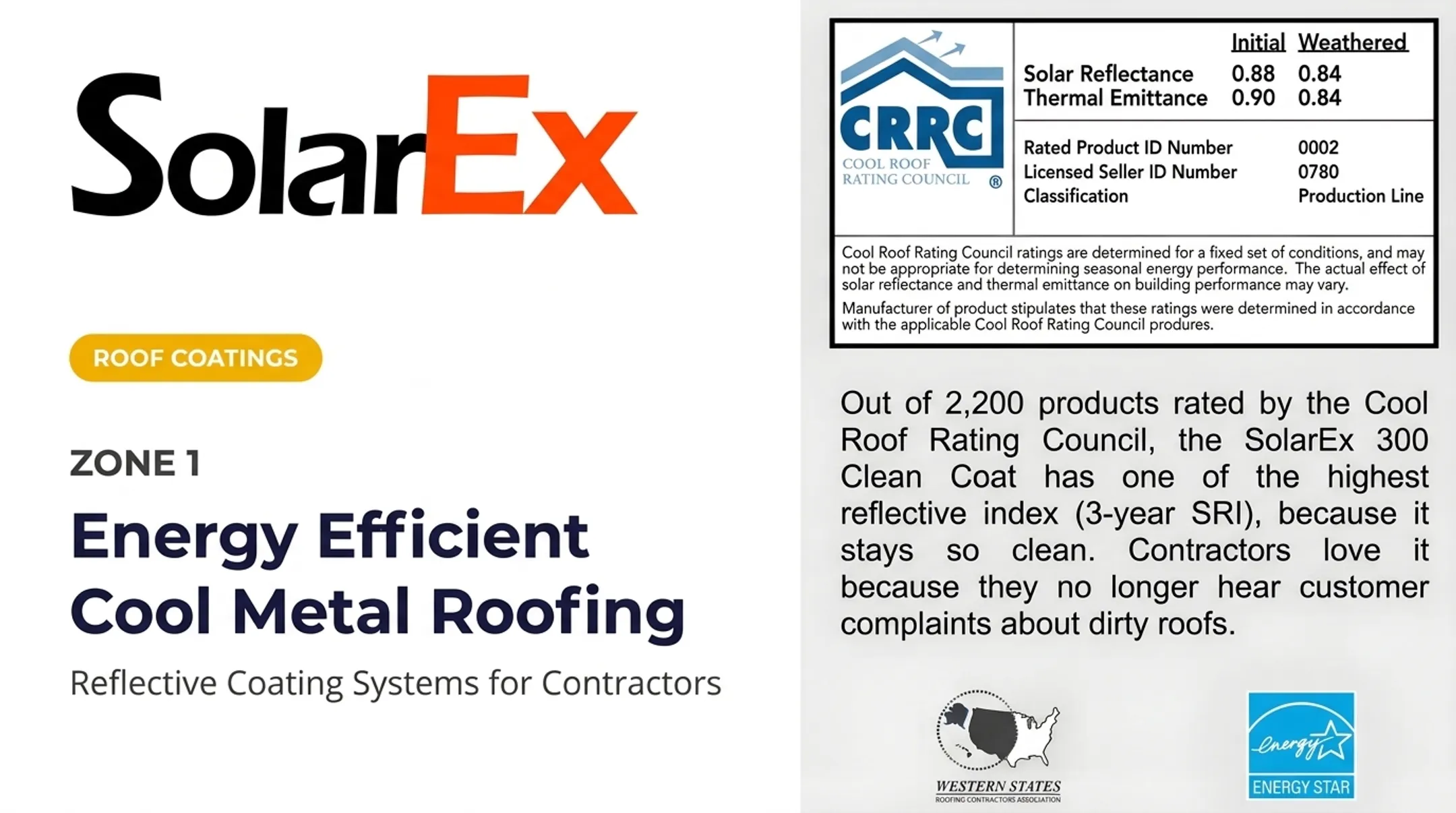
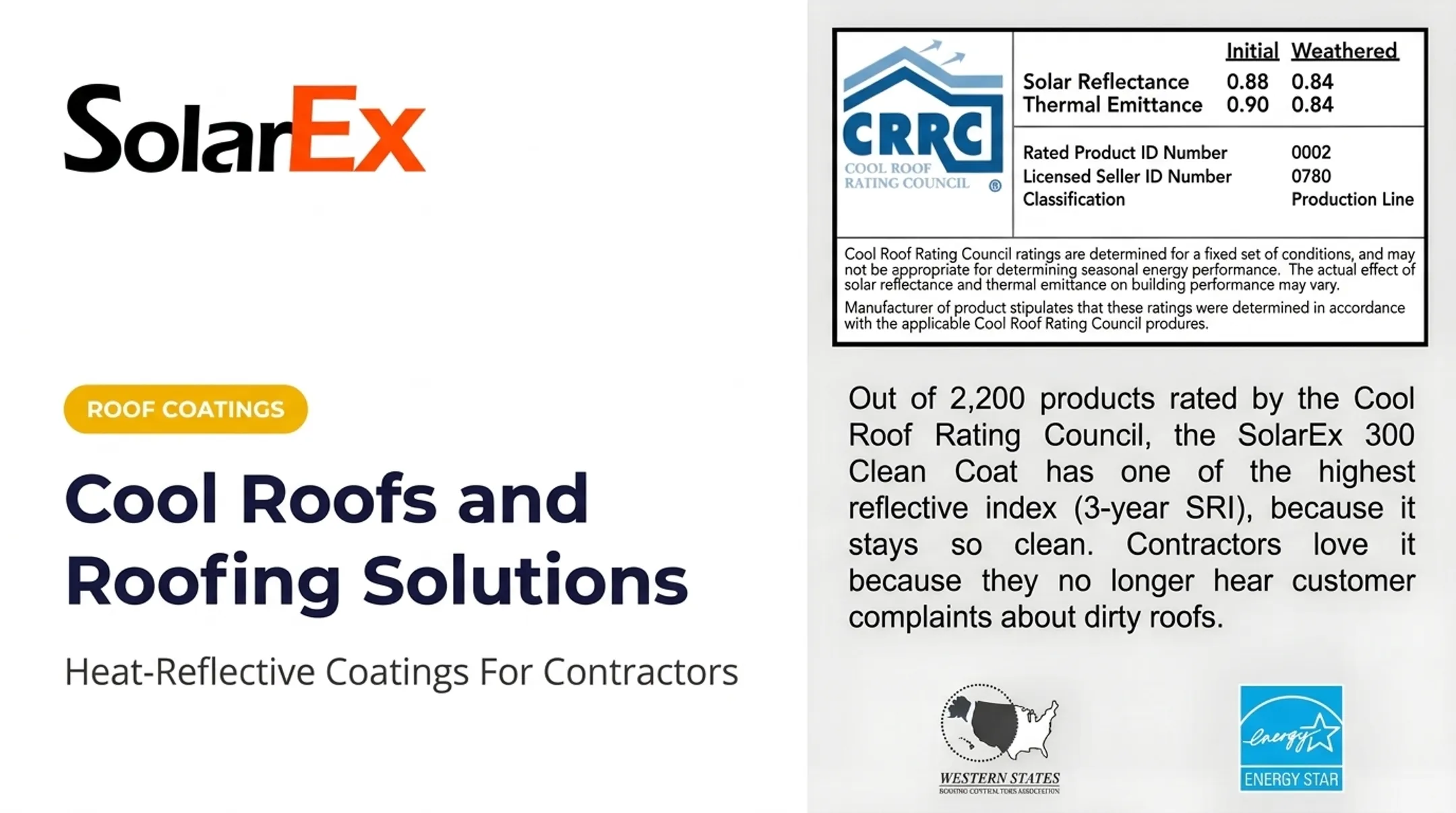
Manufacturer spec sheets list an initial SR value, but that number drops as dirt, weathering, and microbial growth accumulate. Aged values — typically measured after three years — are the number to design around.
SiliconEx 500, for example, carries CRRC Rated Product ID 1448-0001, with solar reflectance of 0.87 initial / 0.72 aged. Thermal emittance holds at 0.90 in both columns.
A strong SR/TE rating still says nothing about waterproofing, wind resistance, fire performance, or structural adequacy. Verify those separately for the full assembly.
Types of Cool Roof Systems
Not every reflective product fits every roof. Here's how the main categories stack up:
| System | Best Fit | Key Consideration |
|---|---|---|
| Reflective coatings (acrylic/silicone) | Retrofits on sound substrates | Surface prep and ponding tolerance vary by formulation |
| Single-ply membranes (TPO, PVC, EPDM) | New construction or planned reroofs | EPDM is naturally black and needs a reflective formulation |
| Modified bitumen | Restoration or new low-slope work | Factory-applied granules or coatings can add reflectivity |
| Light/cool-color metal | New roofs, steep or low slope | Shiny bare metal often has low emittance despite looking reflective |
| Vegetative/green roofs | Structurally reinforced buildings | Works through shading and evapotranspiration, not reflectance |
Reflective Coatings
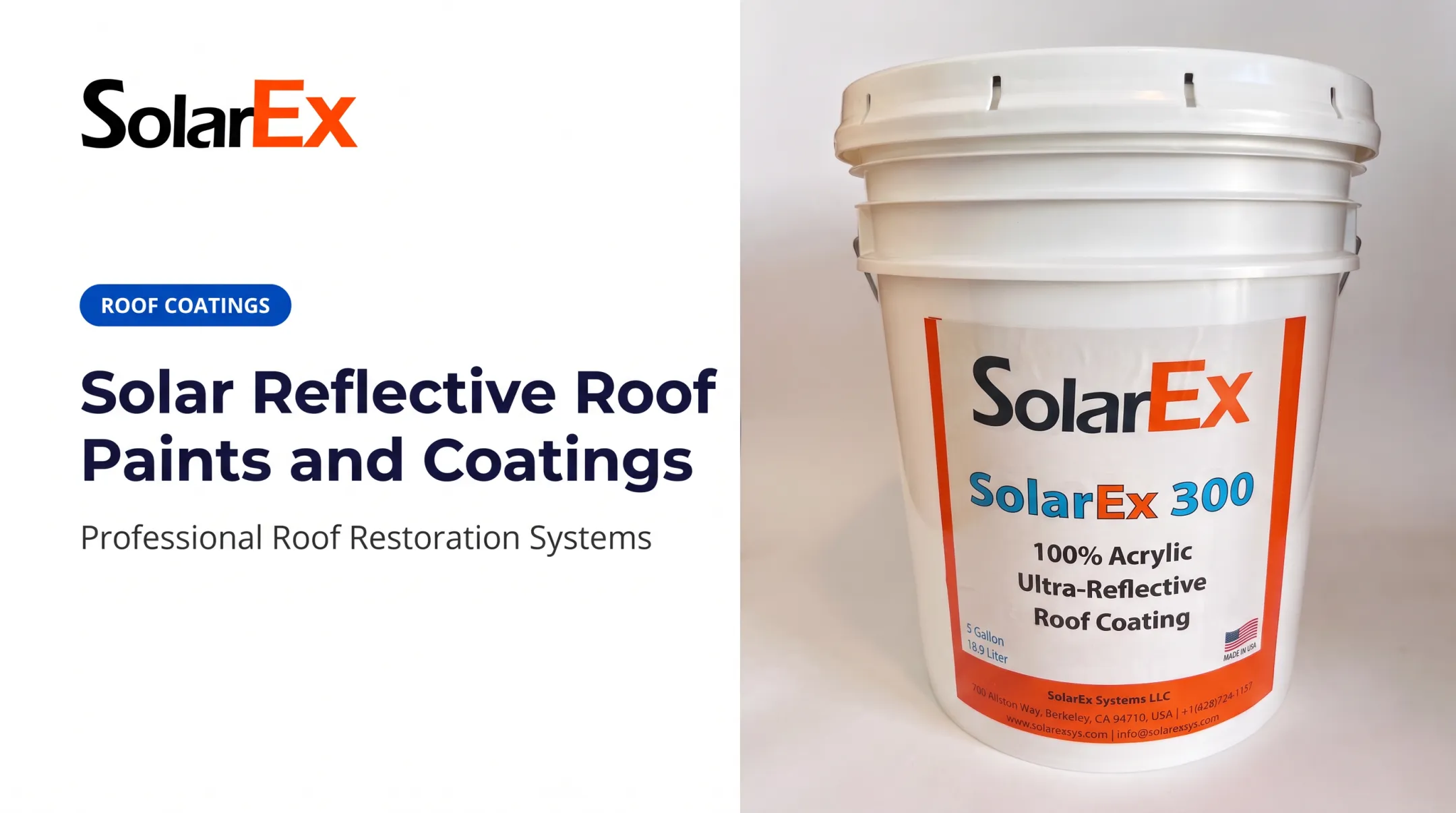
Acrylic coatings, like SolarEx 300, are a common retrofit choice. This 100% acrylic system goes over shingles, mineral cap sheets, decks, or existing roofs without a tear-off.
Silicone systems, such as SiliconEx 500, suit low-slope commercial roofs with standing water. Once cured, the coating is built to handle permanent ponding without softening or re-emulsifying. It can go directly over metal, concrete, wood, TPO, EPDM, and other single-ply membranes.
Prep matters more than the coating itself:
- Pressure-wash the surface
- Remove loose old coatings
- Seal joints and cracks
- Confirm the substrate is dry and structurally sound
Membranes and Metal
Single-ply and modified bitumen systems depend heavily on seam quality, attachment method, and slope. Cool-color or factory-coated metal can post strong reflectance numbers, but a shiny finish alone does not guarantee good thermal emittance. Check the actual CRRC listing.
Vegetative Roofs
Green roofs cool buildings through mass, shade, and plant evapotranspiration rather than a CRRC radiative rating. They demand serious structural capacity, irrigation, and ongoing maintenance, which rules them out for a lot of retrofit budgets.
Matching System to Project
- New construction: membranes, coated metal, or green roof assemblies
- Full replacement: any category, with insulation and drainage upgrades bundled in
- Restoration: coatings over a sound substrate
- Low-disruption retrofit: acrylic or silicone coatings, no tear-off required
If solar is on the roadmap, choose a solar-ready reflective coating early. SolarEx silicone coatings cite up to 88% solar radiation reflectance, so the roof finish supports heat control and future panel compatibility in one decision.
Benefits and Limitations of Cool Roofs
What a Cool Roof Can Realistically Deliver
The core mechanism is reduced solar heat gain, which cascades into a few measurable effects. According to EPA's guidance on reducing heat islands, cool roofs can cut peak cooling demand by 11% to 27% in air-conditioned residential buildings. They also lower roof surface, indoor, and surrounding air temperatures.
Real-world results back this up. One San Jose commercial facility had a 15,000-square-foot modified-bitumen roof with recurring seam leaks. A high-solids silicone restoration sealed the leaks, cut peak indoor temperatures by 12°F, and reduced AC power draw by 18% in the first season.
A separate San Jose client reported a 9°F indoor temperature drop and 22% electricity savings in the first three months.

Community-level benefits follow the same logic:
- Lower peak electricity demand across a grid during heat waves
- Reduced emissions tied to cooling load
- Eases the urban heat-island effect in dense areas
Where Cool Roofs Fall Short
None of this makes a cool roof a cure-all. A few honest limitations:
- Winter heat gain drops too. In colder climates, that can mean a modest heating penalty, though it's usually smaller than the summer savings.
- A coating won't fix a bad substrate. Wet insulation, structural sag, or a failing membrane need repair first.
- Low cooling demand cuts the upside. Buildings with already-efficient envelopes gain less from reflectance alone.
A cool roof works best as one piece of a bigger puzzle. Insulation, air sealing, ventilation, drainage, HVAC efficiency, and solar orientation all interact with roof reflectance to determine actual energy outcomes. Treating the coating as a standalone fix misses most of the picture.
How to Choose, Install, and Maintain a Cool Roof
Start With an Honest Assessment
Before picking a product, get the roof inspected for:
- Age and remaining useful life
- Active leaks or trapped moisture
- Substrate soundness, slope, and drainage
- Ponding water in low spots
- Condition of flashing and penetrations
- Structural capacity for any added weight
Restoration, Coating, or Replacement?
Coating makes sense on a dry, structurally sound roof with repairable defects. Replacement is the better call when insulation is widely saturated, decking is damaged, or the roof has failed across large areas. Building occupancy, tolerance for disruption, and budget all factor into which path fits.
Verify Before You Buy
Ask for documentation covering:
- Initial and aged SR/TE values, not just the marketing number
- Compatibility with your existing substrate
- Required application thickness (dry-film mils, not just wet mils)
- Weather limitations for application
- Fire and wind performance data
- Warranty terms and CRRC or local code compliance
Installation Fundamentals
Application quality determines whether the warranty holds up. Typical steps:
- Clean thoroughly (often a 2,500–3,000 psi wash)
- Repair seams, flashings, and penetrations
- Apply primer where the system specifies it
- Coat to the manufacturer’s dry-film thickness
SolarEx’s silicone system, for example, calls for roughly 1.5 gallons per 100 square feet at 16 wet mils per coat across primer, base, and top layers. Curing generally takes 10–12 hours at 75°F and 50% relative humidity. Keep foot traffic off the surface for at least 48 hours.

Choosing a Contractor
A short checklist before signing:
- References for the specific roof type, not just general roofing work
- A written scope that spells out prep and repair exclusions
- Clear warranty responsibilities (manufacturer vs. installer)
- A maintenance schedule you can actually follow
- Documentation proving the system suits your roof
Maintenance That Protects the Finish
Cool roof performance fades when dirt, ponding, and small defects go ignored. A simple routine keeps reflectivity and the warranty on track:
- Inspect at least twice a year and after major storms
- Clear debris from drains, scuppers, and low spots
- Repair punctures, open seams, and failed flashings promptly
- Plan recoats on the manufacturer’s interval, not after failure
If Solar Is on the Roadmap
If solar panels are part of the plan, sequencing matters. According to NRCA's white paper on PV-ready roofs, roofing materials should have a service life matching or exceeding the planned PV system, and roofing and electrical work should be coordinated rather than treated as separate jobs.
Before installing panels, confirm:
- Remaining roof life versus the PV system’s expected life
- Attachment or ballast method and structural capacity
- Access paths for future roof and array maintenance
- Shading patterns across the array footprint
- Whether coating should be finished before racking goes up
Coating after panels are installed is far more disruptive than doing it first.
How Much Does a Cool Roof Cost?
There's no honest single number for cool roof cost. Pricing depends on inspection findings and project scope, and anyone quoting a flat rate without seeing the roof is guessing.
Major Cost Drivers
- Roof size, slope, and layout complexity
- Coating or membrane type and system warranty term
- Height, access, and staging constraints
- Cleaning, primer, and surface prep requirements
- Leak, substrate, flashing, and penetration repairs
- Local labor rates, permits, and drainage or insulation add-ons
Rough Reference Points
Nationwide installed project costs often fall between $7,500 and $30,000. Around $10,000 is a common ballpark for highly reflective white architectural shingles on a standard 1,500-square-foot roof.
For silicone restoration systems, material pricing on a 20-year system typically runs $1.25 to $1.64 per square foot. That figure is material only. Labor, prep, and repairs are extra, which is why full project quotes vary so widely.

Restoration vs. Replacement, Financially
| Factor | Restoration | Replacement |
|---|---|---|
| Disruption | Lower (no tear-off) | Higher (full removal) |
| Upfront cost | Generally lower | Generally higher |
| Insulation upgrade | Not included | Opportunity to upgrade |
| Best for | Sound substrate, repairable defects | Widespread failure, wet insulation |
Coating a roof that isn't a suitable substrate is a real risk — it can mask a bigger problem temporarily and void warranty coverage later.
Questions to Ask for a Real Estimate
- What's included in surface preparation?
- How will ponding water areas be addressed?
- How is coating thickness verified during application?
- What voids the warranty?
- Which repairs are explicitly excluded from the quote?
Compare lifecycle value, not just the lowest bid. Weigh warranty length, expected cooling-demand impact, remaining roof life, and whether the estimate leaves the roof ready for a future solar installation.
Frequently Asked Questions
What is a cool roof system?
A cool roof system combines high solar reflectance with strong thermal emittance to limit heat absorption. It's the full assembly (deck, insulation, drainage, and coating or membrane), not just a reflective coating applied on its own.
What types of cool roof systems are most effective?
Coatings, membranes, metal, and vegetative systems each reduce heat differently. Effectiveness depends on climate, roof condition, building use, installation quality, and how well the system is maintained afterward.
How much does a cool roof cost?
Cost depends on roof size, material, access, and required repairs. A roof inspection and written scope are needed before you can rely on an estimate.
Do cool roofs work in cold climates?
Cool roofs can still help in cold or mixed climates, but they reduce winter heat gain too, which sometimes creates a modest heating penalty. Check local code requirements and annual energy balance before deciding.
Can you install solar panels on a cool roof?
Yes, solar panels typically pair well with cool roofing. Review the roof's remaining life, structural capacity, attachment method, and maintenance access first. Coordinate the installation sequence between the roofing and solar teams.