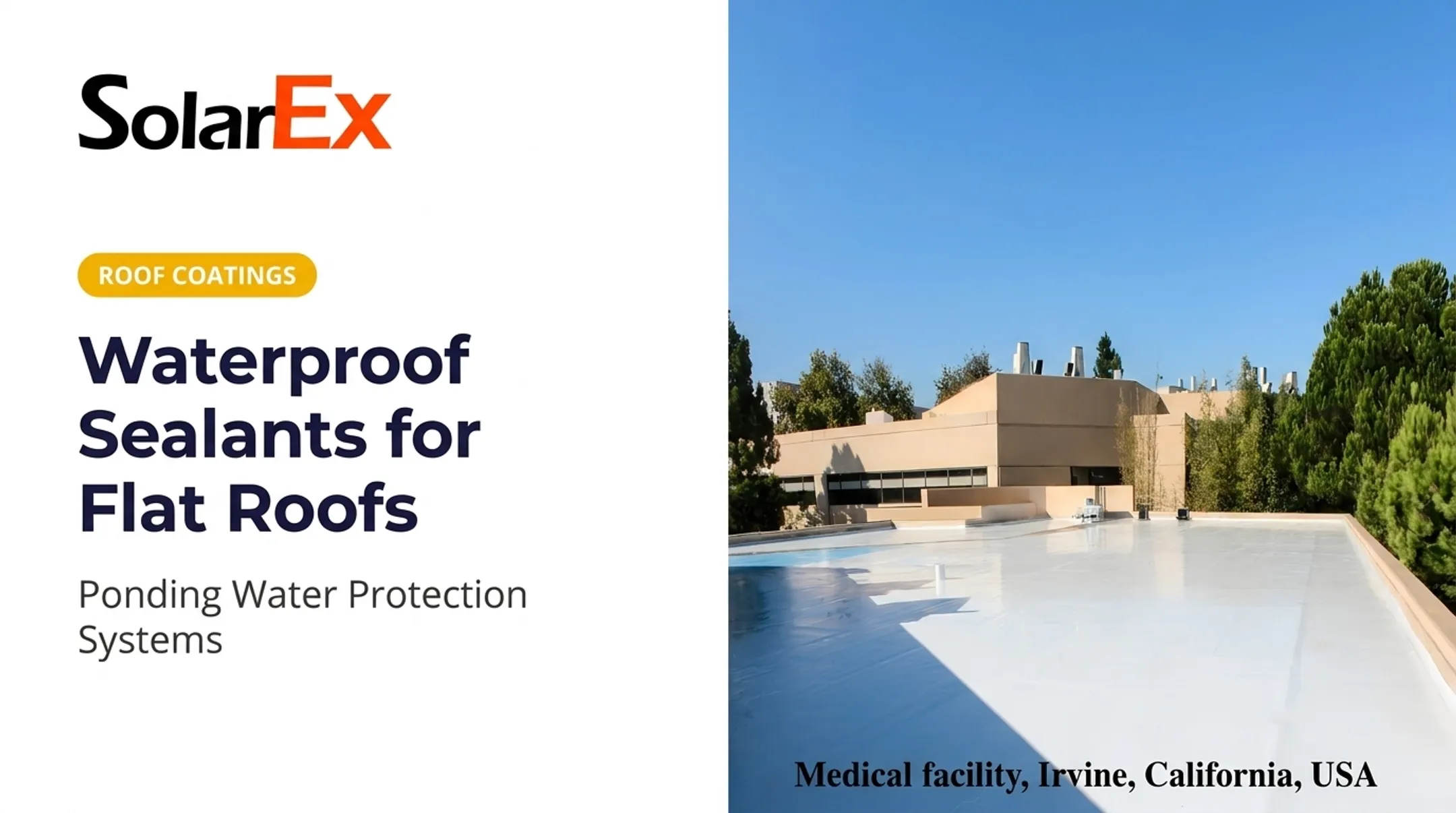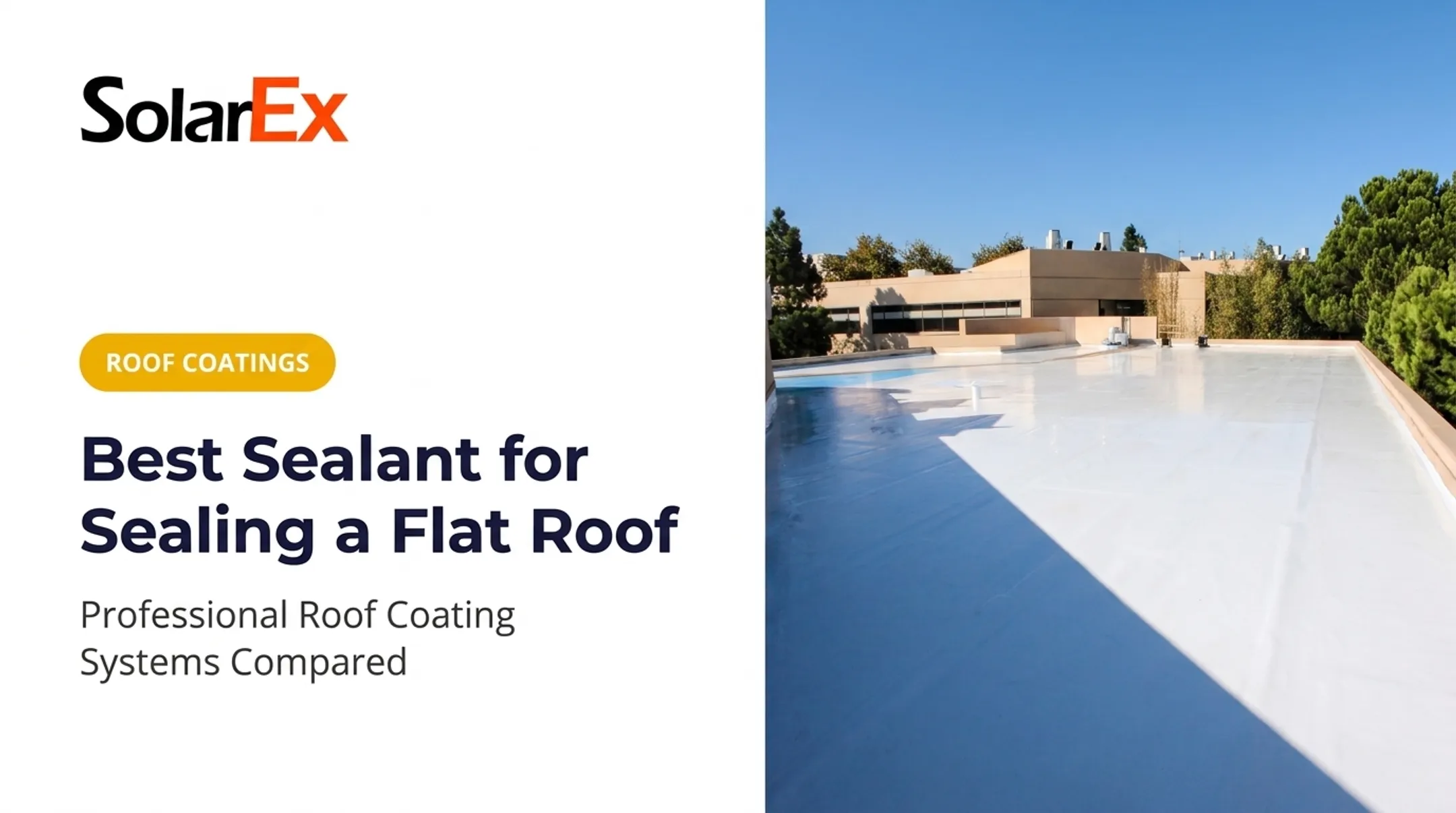

There's no single "best" flat roof repair sealant. The right choice depends on what's failing, what the roof is made of, how much sun and standing water it sees, and whether you're patching one spot or restoring the whole surface.
This guide compares silicone, acrylic, polyurethane, liquid rubber, and reinforcing products side by side, so you can match the sealant to the actual repair instead of guessing.
Key Takeaways
- Silicone handles heavy UV and recurring ponding water best; acrylic, polyurethane, and rubber fit other climates and repair scopes.
- Substrate compatibility, surface prep, coating thickness, and warranty matter as much as the brand on the pail.
- A sealant restores weather resistance. It can't fix drainage defects, saturated insulation, or structural damage alone.
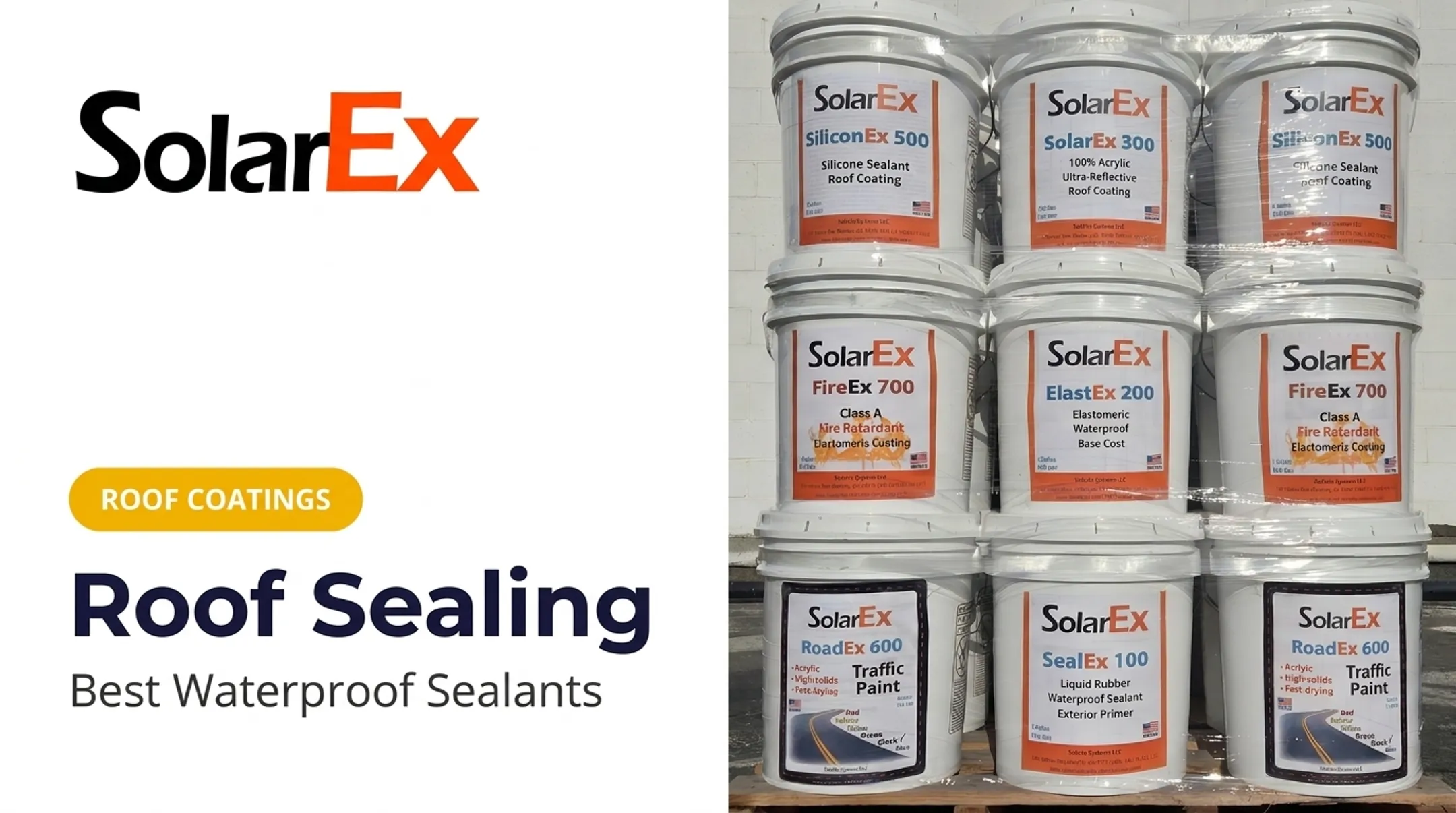
- SolarEx offers USA-made silicone and acrylic coatings for flat-roof restoration; confirm current specs before you choose a system.
Overview of Flat Roof Repair Sealants in the U.S. Roofing Market
Flat roof repair sealants close cracks, seams, penetrations, and membrane defects. The category splits into two rough groups: cartridge-applied sealants and tapes for spot repairs, and full-surface liquid coating systems for broader restoration.
Flat and low-slope roofs need this extra attention because they don't drain the way pitched roofs do. The National Roofing Contractors Association defines ponding as water that stays on a roof longer than expected under normal drying conditions. Proper drainage design should clear water within 48 hours of a rain event.
When that doesn't happen, membranes take a beating from standing water, thermal expansion, foot traffic, and rooftop equipment loads all at once.

Main product families you'll encounter:
- Silicone – strong UV and ponding-water resistance, long service life
- Acrylic – budget-friendly, reflective, but weaker where water sits
- Polyurethane – tough, impact-resistant, good for foot traffic
- Liquid rubber/bituminous elastomers – flexible membranes for waterproofing and localized repair
- Asphaltic repair products – fast, low-cost patching for specific substrates
- Seam tapes and reinforcing fabric – added strength at joints and penetrations
Each family has trade-offs. The products below are organized by the repair job they're actually suited for, not ranked as one universal winner.
Top Flat Roof Repair Sealants for Different Repair Needs
Before comparing specific products, it helps to know what to check on every technical data sheet:
- Waterproofing performance and ponding-water tolerance
- UV stability and flexibility across temperature swings
- Adhesion to your specific roof substrate
- Application method (brush, roller, spray) and coverage rate
- Curing time and weather window
- Long-term value, not just the price per gallon
SolarEx SiliconEx 500 Silicone Roof Coating
SiliconEx 500 is a 100% silicone, solvent-free, single-component, moisture-cured coating built for flat and low-slope roofs where ponding water and UV exposure are ongoing concerns. It cures into a seamless, elastic membrane rather than functioning as a spot-patch product, which makes it better suited to restoration than to a single emergency leak.
Specs to verify on the current data sheet before you buy:
- Initial solar reflectance around 87%, with reflectivity tracked over time
- Permanent ponding-water resistance after full cure
- Low-VOC formulation (roughly 8 g/L per internal testing)
- Application rate of about 16 wet mils per coat, three coats totaling 45 mils
- Material warranties available at 10, 15, or 20 years depending on system spec
| Attribute | Detail |
|---|---|
| Product type | 100% silicone, moisture-cured liquid membrane |
| Substrates | Metal, concrete, wood, TPO, EPDM, single-ply, modified bitumen |
| Application | Brush, roller, or airless spray |
| Ponding water | Rated for permanent ponding after cure |
| Primer | Generally none; bleed-blocking primer over bitumen, anti-rust primer over corroded metal |
| Coverage | ~0.6–1.0 L/m² per coat; priced around $1.25–$1.64 per sq ft for a 20-year system |
| Professional install | Recommended for warranty-qualified applications |
Liquid Rubber Waterproof Sealant
This single-component, liquid-applied bitumen and polymer elastomeric membrane fits broader waterproofing jobs as well as isolated crack, joint, or flashing repairs. It covers roofing materials, concrete, foundations, and existing metal or BUR systems.
What to confirm before applying:
- Compatibility with your specific roof membrane
- Whether it's rated for standing water (its technical sheet doesn't state a ponding duration, so don't assume permanent tolerance)
- Number of coats needed and expected dry film thickness
- Reinforcing fabric requirements at seams and details
It applies by brush, roller, or single-component sprayer, is solvent-free and low-odor, and showed no degradation after 250 hours of accelerated UV testing. Full cure takes 24–48 hours at 75°F and 50% relative humidity, longer in cold or humid conditions.
| Attribute | Detail |
|---|---|
| Chemistry | Bitumen/polymer elastomeric membrane |
| Substrates | Roofing, concrete, metal, BUR, modified bitumen |
| Application | Brush, roller, elastomeric-rated sprayer |
| Ponding water | Not specified; verify before relying on it for permanent standing water |
| Weather limits | Cold/humid conditions extend cure time |
| Maintenance | Follow manufacturer recoat guidance for high-wear areas |
Rubberseal White Liquid Rubber Waterproofing
Rubberseal's White formula is a water-based, low-VOC elastomeric coating that cures into a flexible, bright-white, seamless membrane. It's a solid option for small cracks, seams, and penetration areas prone to recurring moisture, especially where reflectivity matters.
Important distinction: this version is built for rain and temporary standing water, not permanent ponds or pools. If your roof holds water for days at a time, the manufacturer directs you to their Black formulation instead.
Application basics:
- Roller, brush, or airless spray
- Multiple uniform coats, roughly 32 sq ft per gallon at a 40-mil total build
- Optional fabric reinforcement at joints and details
- Full cure around 72 hours at 70°F; apply only between 50–95°F with no rain expected in the next 6 hours
| Attribute | Detail |
|---|---|
| Membrane type | Water-based elastomeric, bright white |
| Substrates | Roofs, RV/mobile home roofs, concrete, masonry, exterior walls |
| Ponding water | Temporary standing water only; not for permanent ponds |
| Primer | Not specified generally; surface must be structurally sound and pre-repaired |
| Cure conditions | 50–95°F, no rain within 6 hours |
| Heavy traffic | Not addressed in published data; verify separately |
GacoFlex S42 Commercial Silicone Roof Coating
For larger commercial jobs, compare GacoFlex S42 against your project specs. It's a high-adhesion, solvent-free, single-component, moisture-curing 100% silicone that typically doesn't need primer over most substrates, though concrete and some TPO membranes are exceptions.
Facility managers and contractors should focus on:
- Restoration use only: the product is limited to sound membranes needing renewal, not roofs with active structural failure
- Minimum 18-mil dry film thickness, applied at roughly 1.25 gallons per 100 sq ft on smooth surfaces
- No application if rain is expected within 1 hour, or in temperatures above 120°F or below 32°F
- VOC content under 50 g/L
The published S42 data doesn't state a specific permanent-ponding claim the way some silicone systems do, so confirm that detail directly with current documentation before specifying it for a roof with known low spots.
| Attribute | Detail |
|---|---|
| Formulation | Solvent-free, single-component, moisture-cured silicone |
| Substrates | Metal, weathered single-ply, SPF, aged SBS/APP/BUR, concrete |
| Ponding water | Not explicitly stated; confirm with current PDS |
| Primer | Not required over most substrates; concrete needs primer |
| Application scale | Large-area spray or roller, project scale not specified |
| Foot traffic | Allow 24–48 hours before light traffic |
Henry 885 Tropi-Cool and 208R Rubberized Wet Patch
Henry offers two distinct products that serve different jobs. Henry 885 Tropi-Cool is a 100% silicone, moisture-curing sealant designed for detail work: seams, flashing, fasteners, and drains on BUR, single-ply, SPF, metal, and previously coated roofs.
It can be applied damp, wet, or dry and works between 35–120°F. It is rated ponding-water resistant according to its current technical data sheet. Tack-free time runs 1–2 hours, with full cure around 48 hours.
Henry 208R Rubberized Wet Patch is a different animal entirely, an asphalt and SBS polymer cartridge product built for emergency patching in driving rain or standing water. It seals holes, cracks, flashing, and metal-edge joints on composition, mineral-cap, and metal roofs.

- Not recommended over gravel, rubber, PVC sheet roofing, or wood shingles
- May underperform over some APP torch-down membranes
- Topcoat within 30 days per the manufacturer—this is a bridge fix, not a standalone long-term solution
| Attribute | 885 Tropi-Cool | 208R Wet Patch |
|---|---|---|
| Chemistry | 100% silicone | Asphalt + SBS polymer |
| Best use | Detail/seam repair, flashing | Emergency patch, active leaks |
| Ponding water | Resistant | Handles standing water short-term |
| Application | Trowel/putty knife, 1/8–1/4 in | Cartridge application |
| Long-term status | Suitable for lasting repair | Recommend topcoat within 30 days |
How We Chose the Best Flat Roof Repair Sealants
Ranking these products meant looking past marketing language about "universal waterproofing" and focusing on verified technical performance.
Substrate compatibility came first. EPDM, TPO, PVC, modified bitumen, built-up roofing, metal, and concrete all react differently to coatings. Silicone can work on most of these when the surface is dry, firmly attached, and passes an adhesion test. Manufacturer documentation should confirm every claim rather than assuming cross-product compatibility.
Ponding-water resistance got separate scrutiny from drainage. A coating that resists standing water can still fail early if the real drainage problem—a low spot, clogged drain, or saturated insulation—never gets fixed. That distinction matters more than most product pages admit.
Testing standards also shaped our evaluation. ASTM D6083 governs water-dispersed acrylic elastomeric coating properties, including elongation, tensile strength, and weathering resistance, but it explicitly stops short of providing application guidance. Lab specs and field installation are two different things.

Other factors we weighed:
- Flexibility and adhesion around seams, vents, skylights, and pipes
- Temperature tolerance and puncture/abrasion resistance
- Practical installation needs: cleaning, primer, reinforcing fabric, coat count, cure time, and VOC/odor limits
- Total value: coverage rate, labor, warranty terms, and recoating schedule—not just container price
An incompatible product applied at the wrong thickness can cost more in redo labor than a slightly pricier, correctly specified system ever would.
Conclusion
Matching the sealant to the roof isn’t optional. The best flat roof repair sealant is the one suited to your membrane type, leak location, drainage condition, and climate exposure—not the one with the biggest marketing budget.
Before applying anything, walk the roof and check:
- Seams and penetrations
- Flashing and drains
- Spots where water pools after rain
If you find structural damage or widespread membrane failure, fix that first. No coating repairs a rotted deck.
If you're weighing a reflective roof coating—especially one that can support later solar or energy-efficiency upgrades—SolarEx can review product fit and project scope for your building. Reach the team at +1 (877) 888-2278 or info@solarexsys.com for a technical consultation.
Frequently Asked Questions
What is the best sealant for a leaking flat roof?
It depends on roof material, leak location, and whether you're patching one spot or coating the full surface. Silicone handles UV and ponding; acrylic suits dry, well-drained roofs; rubber or tape works for spot fixes. Confirm substrate compatibility and fix drainage before you apply anything.
Why does my flat roof leak in heavy rain?
Ponding water, blocked drains, failed seams, damaged flashing, and worn membrane are the usual culprits—often with wind-driven rain at penetrations. Sealant can slow damage but won't fix drainage or structural problems underneath. Inspect thoroughly before choosing a product.