
Introduction: Ponding Water Flat Roof Coatings
A puddle that disappears within a day is normal roof behavior. Water that's still sitting there 48 hours after the rain stops is a different problem entirely, and left alone it stresses the membrane, opens leak paths, and adds dead load the deck was never meant to carry.
This article breaks down why ponding water happens, what a roof coating can and can't fix, and how silicone and elastomeric systems differ when standing water is part of the picture. We'll also cover when drainage or structural repairs need to happen before any coating goes down.
By the end, you'll have a practical framework for evaluating your roof before choosing a product or signing off on a restoration project.
Key Takeaways
- Coatings form a seamless moisture barrier but can't fix blocked drains, deck sagging, or saturated insulation
- Chronic ponding needs drainage, membrane, and structural checks before any coating is applied
- Silicone is commonly used for persistent ponding areas; acrylic often needs positive drainage first
- Match prep, primer, and coverage rates to the manufacturer's technical data sheet
Why Ponding Water Happens—and Why It Matters
The National Roofing Contractors Association defines ponding as water that remains on a roof beyond 48 hours after rainfall under conditions conducive to drying. That 48-hour mark is the industry's working threshold. Confirm it against current NRCA guidance when you evaluate a specific roof.
Drainage Problems Are the Usual Culprit
Most ponding traces back to how water is supposed to leave the roof:
- Inadequate slope built into the original design
- Clogged drains, scuppers, or debris-blocked outlets
- Poorly positioned drain locations relative to low spots
- Crickets that fail to divert water around obstructions
- Parapet walls or rooftop equipment blocking natural flow paths
Structural and Substrate Issues
The deck itself can create ponding even when drains are clear. Deck deflection from age or load, building settlement, and compressed insulation all form new low points over time. Heavy rooftop equipment (HVAC units, generators, solar mounts) adds concentrated weight that can deepen those depressions further.
Water sources outside the drain layout matter too: HVAC condensate lines dumping in one spot, runoff cascading from a higher roof section, and snowmelt pooling around curbs or skylights.
Why this matters. Recurring ponding:
- Accelerates membrane degradation and stresses seams and flashings
- Invites algae growth and saturates insulation
- Adds structural load on the deck
- Triggers interior leaks that can turn a coating job into a full restoration
Quick inspection checklist:
- Photograph low areas 24 and 48 hours after rainfall
- Note exactly how long water remains in each spot
- Inspect drains and scuppers from a safe vantage point
- Call a professional if you see active leaks or deck flex
Can Flat Roof Coatings Solve Ponding Water?
A roof coating forms a continuous, seamless layer over an existing roof surface. When detailed correctly around seams and penetrations, it seals minor discontinuities, reduces moisture exposure, and can extend the service life of a roof that's otherwise sound.
Here's the distinction that matters most: ponding resistance is not the same as drainage correction.
According to the Roof Coatings Manufacturers Association, roofs should be designed for positive drainage. Some coatings are engineered to withstand standing water, but not every product is: check the manufacturer's specific guidance.
A coating that resists ponding still won't lift a sagging deck, clear a clogged drain, or replace insulation that's already soaked through.
When Restoration Makes Sense
Coating over an existing roof tends to work when:
- The underlying structure and membrane are still sound
- The substrate is dry or has been properly remediated
- Surface damage is limited to seams, minor cracking, or wear
- Material compatibility has been confirmed through adhesion testing
Pre-Coating Work That Often Gets Skipped
Low areas frequently need attention before a coating goes on:
- Drain and scupper cleaning
- Tapered insulation or crickets to redirect flow
- Localized leveling with liquid roof patch or spray foam
- Flashing repairs and reinforcement at penetrations
Don't coat yet if you see:
- Active leaks with an unidentified source
- Widespread blistering or delamination
- Exposed or deteriorated insulation
- An unsafe deck
- Standing water tied to a drainage failure that hasn't been corrected
Coating over these conditions just hides the problem until it resurfaces—usually as a bigger repair bill.
Choosing Between Silicone, Acrylic, and Other Elastomeric Coatings
Not all coatings handle ponding water the same way. The chemistry behind each product type drives how it performs when water sits on the roof for extended periods.
Why Silicone Gets Evaluated for Chronic Ponding
Silicone cures through a moisture-triggered reaction rather than water evaporation. That chemistry is why it's often the first product considered for areas with persistent standing water.
A comparative trade article in Building Enclosure notes that silicone technology generally outperforms acrylic on waterproofing capability. Silicone can also tolerate light rain within roughly 15 minutes of application, depending on temperature and humidity.
Silicone isn't flawless, though. Cured surfaces can get slippery when wet, and future recoating requires silicone-compatible materials since many other coating chemistries won't bond reliably on top.
Where Acrylic Fits
Acrylic coatings cure through water evaporation, which makes them more sensitive to rain during the drying window. They tend to offer strong reflectivity and flexibility at a lower cost.
Standard acrylic formulations generally struggle with persistent ponding unless the manufacturer has approved that use case. Acrylic is usually a better fit for well-drained, sloped surfaces.
Where Urethane Comes In
Urethane and reinforced systems get considered when a roof sees heavy foot traffic, mechanical wear, or impact exposure, such as rooftop equipment service paths. These systems trade some flexibility for tensile strength and abrasion resistance, though performance varies significantly by specific product formulation.

Comparison at a glance:
| Attribute | Silicone | Acrylic | Urethane |
|---|---|---|---|
| Ponding tolerance | Generally strong | Often limited | Product-dependent |
| Cure mechanism | Moisture-triggered | Water evaporation | Varies |
| Cost | Higher | Lower | Mid-range |
| Traffic resistance | Moderate | Lower | Higher |
Primer and Reinforcement Decisions
Substrate condition dictates what goes down before the topcoat:
- Rusted metal typically needs a rust-inhibitive primer
- Modified bitumen or built-up roofing usually needs a bleed-blocking primer to stop asphalt migration into the coating
- Adhesion testing on a representative section confirms whether primer is necessary
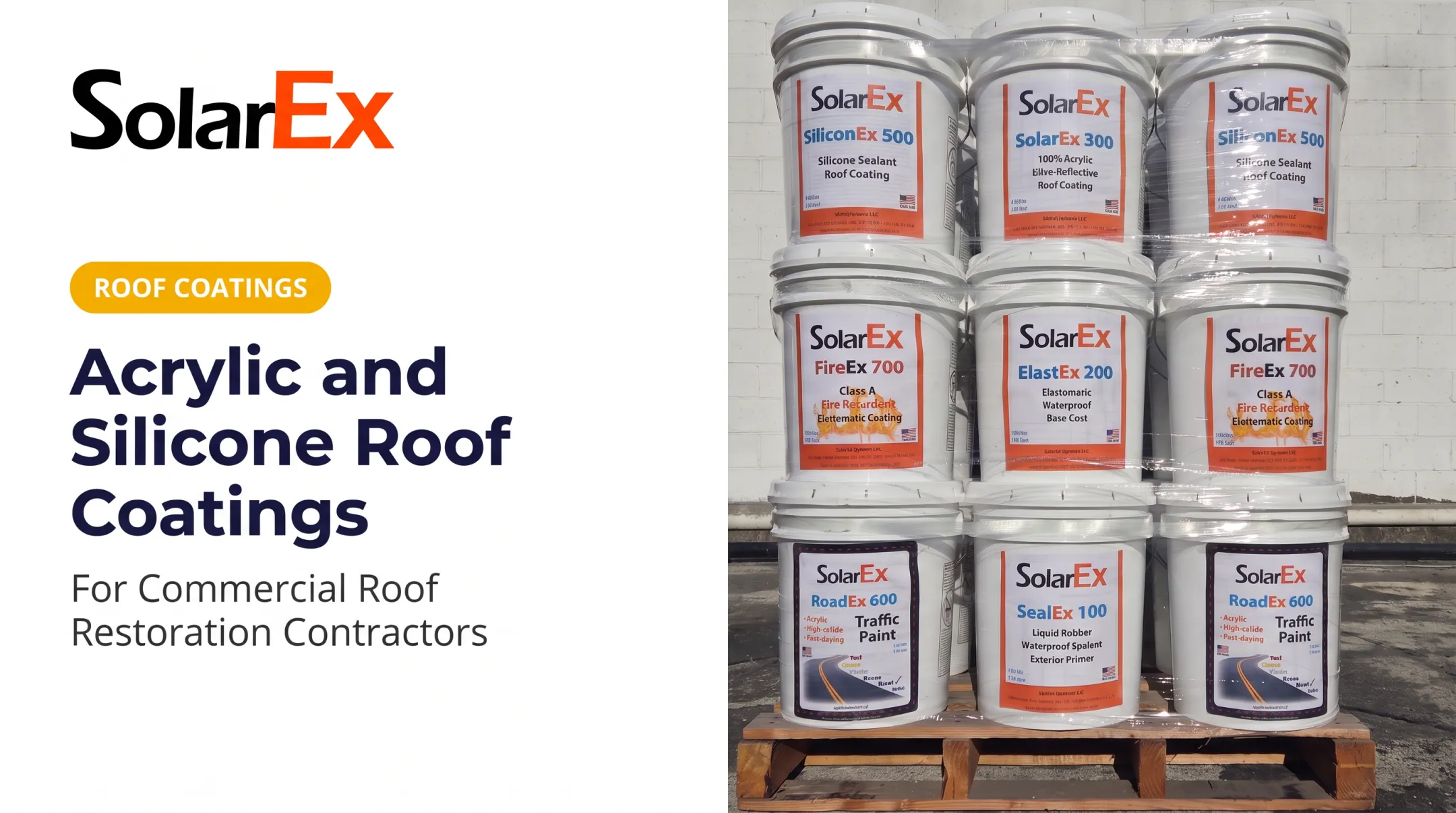
SolarEx's SiliconEx 500 is a solvent-free, single-component, moisture-cured silicone that forms a monolithic membrane designed to withstand permanent ponding water once fully cured.
It is not intended for continuously submerged conditions like tanks or pools. It still requires a structurally sound substrate underneath; coating chemistry doesn't override roof condition.
How to Apply a Ponding-Water Roof Coating Correctly
Application quality determines whether a coating performs for years or fails within a season. Start with documentation, not the sprayer.
Evaluate Before You Prep
- Map every ponding area
- Identify the existing membrane type
- Locate any known leaks
- Confirm where drainage routes actually lead
- Assess how much foot traffic the roof handles
This tells you whether the roof is even a candidate for restoration.
Surface Preparation Steps
- Clean thoroughly — remove dirt, debris, and biological growth
- Dry completely — moisture under a coating causes blistering
- Clear drains and scuppers — before, not after, coating
- Remove loose coating and repair seams — patch penetrations and cracks
- Treat rust or bitumen bleed — with substrate-appropriate primer

For substrates like TPO, EPDM, PVC, modified bitumen, or spray polyurethane foam, run an adhesion test on a representative section first. This single step prevents most early coating failures.
Handling Low Areas
Cosmetic filling is not the same as drainage correction. True correction means tapered insulation, crickets, or approved slope-building materials—not just spreading extra coating into a depression and calling it fixed.
Application Controls That Protect Performance
- Confirm the weather window: no rain expected for at least 24 hours
- Check substrate moisture and ambient temperature/humidity ranges
- Agitate or mix the product per the technical data sheet
- Measure wet-film thickness during application, not after
- Keep foot traffic off the surface until fully cured
Coverage rate and dry-film thickness always come from the specific product's technical data sheet. As a reference point, SolarEx's SiliconEx 500 coverage runs roughly 1.5 gallons per 100 square feet for a 10-year system, up to 2.5 gallons for a 20-year system. Those numbers need field verification to protect both performance and warranty eligibility.
Preventing Ponding Water After Restoration
A coating isn't a one-time fix. It's the start of ongoing roof maintenance.
Build a Recurring Maintenance Plan
- Clean drains and scuppers on a set schedule, not just when problems appear
- Remove debris before it washes into and clogs drainage points
- Inspect seams, penetrations, and flashing details regularly
- Check rooftop equipment discharge points for new drainage interference
- Document any low areas that are new or expanding
What to Watch For on a Coated Roof
Watch coated surfaces for:
- Dirt pickup, cracking, blistering, or loss of adhesion
- Punctures from dropped tools or heavy traffic near equipment service paths
Walkway pads help protect high-traffic zones where crews service rooftop equipment.
Seasonal Considerations
NRCA recommends inspecting roofs at least twice a year, in spring and fall, plus after any severe storm. Snow and freeze-thaw cycles add weight and can shift drainage patterns; heavy rain seasons stress drains that haven't been cleared.
Summer heat rarely needs its own inspection window. Avoid foot traffic in extreme temperatures, when the coating is more vulnerable to damage.
When a Coating Is Not Enough
Some roofs are past the point where a coating makes sense. Catching that early costs less than waiting for the next leak cycle.
Replacement or major reconstruction usually becomes the better path when:
- Membrane failure is widespread rather than localized
- Leaks keep recurring despite repeated repairs
- Insulation is saturated across large sections of the roof
- The deck shows structural movement, corrosion, or significant deflection
- Delamination has spread beyond isolated spots
- Drainage defects can't be corrected without disproportionate cost
Delaying action rarely saves money. Unresolved roof issues tend to escalate into saturated insulation, corroded fasteners, mold growth, and damaged decking. Those repairs cost far more than fixing the problem at the first clear warning signs.

Before committing either direction:
- Get a written roof condition assessment from a qualified professional
- Request a scope that separately identifies drainage and substrate repairs
- Compare restoration costs against full replacement, not just sticker price
- Check warranty exclusions related to ponding water and maintenance history
If the assessment shows a sound deck, correctable drainage, and localized membrane issues, restoration can still beat replacement. A compatible silicone coating such as SolarEx can support that path once drainage and substrate repairs are in the scope. It does not replace those repairs, and it should not be used to paper over a roof that already needs reconstruction.
Frequently Asked Questions
How to stop water ponding on a flat roof?
Start with drain and scupper maintenance, then correct slope or low areas through tapered insulation or crickets. Have the membrane and structure inspected, and consider a ponding-resistant coating once drainage is fixed.
How long does it take for elastomeric roof coating to dry completely?
Drying and full cure time depend on the specific chemistry, film thickness, temperature, humidity, and airflow at the job site. Always check the product's technical data sheet for exact timing.
Is elastomeric roof coating waterproof?
Elastomeric coatings offer strong water resistance, but that's different from a complete waterproofing system. Seams, penetrations, drainage, and correct application all determine actual performance.
Is silicone roof coating suitable for a flat roof with ponding water?
Silicone is frequently chosen for persistent ponding because of its moisture-cured chemistry and water resistance. Compatibility, adhesion, and underlying roof condition still need to be verified before application.
Can you coat over an existing flat roof membrane?
Often, yes—provided the substrate is clean, dry, and passes an adhesion test. Primer requirements and manufacturer-approved system specifications vary by membrane type, so check compatibility first.
When does ponding water mean a flat roof needs to be replaced?
Widespread membrane failure, saturated insulation, structural deck damage, or drainage defects that can't be economically corrected typically point toward replacement. A professional roof condition assessment confirms the right path.