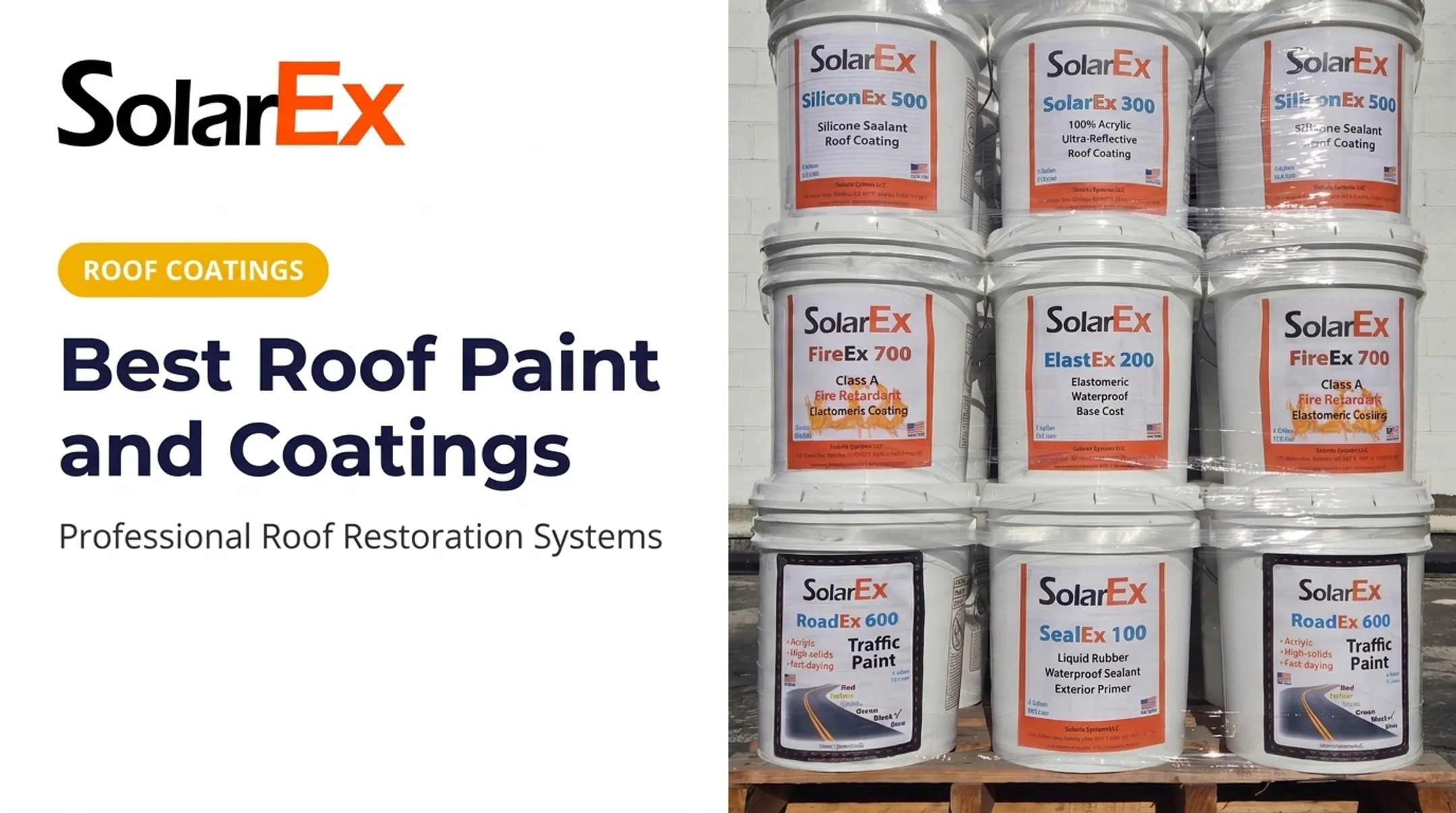

Many homeowners lump together four very different products: reflective cool-roof coatings, waterproofing membranes, shingle rejuvenators, and general "roof paint." They're not interchangeable, and picking the wrong one can cause real problems.
This article covers when a coating makes sense, when it doesn't, what it costs, and what to check before you hire anyone or buy a single gallon. One thing worth stating upfront: no coating fixes rotten decking, stops a leak at its source, repairs failed flashing, or corrects a ventilation problem. Those need actual repair work first.
Key Takeaways
- Confirm product compatibility with your shingle manufacturer before applying any coating.
- Reflective coatings cut heat only on compatible systems; others waterproof or restore.
- Wrong DIY product or roof choice risks warranty voids, moisture issues, and fire-rating problems.
- Lowest sticker price often costs more after prep, repairs, and replacement risk.
Can Roof Coatings Work on Asphalt Shingles?
A roof coating is a liquid-applied material that cures into a continuous protective or reflective film sitting on top of the shingle surface. A rejuvenator or penetrant works differently. It's designed to soak into the shingle and re-soften the asphalt binder rather than form a surface layer.
That distinction matters more on asphalt shingles than on almost any other roofing material. Shingles are a layered product with exposed mineral granules bonded to an asphalt base. Anything that changes flexibility, drainage, vapor movement, fire performance, or granule adhesion affects the entire roof assembly, not just the surface.
Why Manufacturer Guidance Comes First
The Asphalt Roofing Manufacturers Association has taken a firm public position on this. ARMA "strongly advises against the field application of any type of coatings or rejuvenators over installed asphalt shingles," according to its technical bulletin on the subject. That bulletin cautions that manufacturer recommendations and local codes should take priority over any product claim.
This doesn't mean every coating is unsafe or ineffective everywhere. It means the burden of proof sits with the specific product, on the specific shingle type, with documented approval. A coating might be worth considering only if:
- The product has documented compatibility with your exact shingle type
- The roof passes a physical inspection first (no active leaks, no structural issues)
- The manufacturer's warranty terms are understood in writing before application
Products in this space aren't all making the same promise, either. Claims range from solar reflectivity and waterproofing to appearance refresh or granule restoration. One product shouldn't be assumed to deliver all of them at once — check what the specific formulation is actually rated for.
The practical rule: don't coat first and inspect later. Verify the roof, the product, the warranty, and local code requirements before you buy anything.
Benefits, Risks, and Roof-Eligibility Checks
When the product is compatible and the roof qualifies, an approved coating can deliver real advantages.
Potential benefits:
- Reduced solar heat absorption on reflective systems
- Added surface protection against UV and weathering
- Refreshed appearance on a faded, weathered roof
- Support for lower cooling loads on reflective systems
On that last point, the EPA notes that cool roofs can reduce peak cooling demand by 11-27% in air-conditioned residential buildings. That figure comes from cool-roof research broadly and covers reflective roofing materials in general.
It is not proof that coating your existing shingle roof will deliver the same result. Treat it as context for why reflectivity matters, not a guaranteed outcome for your roof.
What a Coating Cannot Do
A coating cannot repair rotten decking, replace missing or broken shingles, fix flashing failures, correct poor attic ventilation, or stop leaks caused by underlying construction defects. If any of those apply, repair or replacement comes first.
Documented Risks of Incompatible Products
Owens Corning's technical bulletin on roof coatings and rejuvenators lists specific problems tied to unknown or incompatible chemistries: blisters, curling, asphalt softening or flow, altered fire-resistance performance, trapped moisture, premature aging, and appearance changes. Its warranty position is blunt: the manufacturer states its Limited Lifetime Product Warranty won't apply if a rejuvenator or coating is applied to the shingles.

That position is manufacturer-specific, not universal. Still, it shows the warranty risk is real and needs checking, not assuming.
Roof-Eligibility Checklist
Before considering any coating, check:
Shingle and surface condition:
- Shingle age and overall condition
- Extent of granule loss
- Brittleness or curling at the edges
- Algae or moss growth
- Any active or past leaks
Structure, access, and history:
- Attic ventilation adequacy
- Roof slope and access
- Flashing condition around penetrations
- Decking integrity underneath
- Any previous coating or treatment history
Replacement is generally the better call for widespread damage, recurring leaks, exposed underlayment, structural deterioration, or advanced shingle failure, or when the roof cannot meet the coating manufacturer's requirements.
Confirm eligibility with the shingle manufacturer, the coating manufacturer, and a qualified roofing professional before you proceed. Check your local building department, insurer, or HOA when those rules apply.
How to Choose and Apply a Coating
Not every "roof coating" on a shelf is built for shingles. Product categories break down roughly like this:
| Category | Primary Purpose | Shingle-Approved? |
|---|---|---|
| Acrylic/elastomeric reflective coatings | Heat reflection, UV protection | Only specific formulations |
| Silicone-based coatings | Moisture resistance, ponding water | Typically low-slope/membrane focused |
| Asphalt-compatible sealants | Surface protection, minor repair | Varies by product |
| Rejuvenators/penetrants | Restore binder flexibility | Product-specific, not universal |
Verify which category your product actually falls into and whether it's approved for asphalt shingles specifically. Do not assume approval from marketing language alone.
Technical Information to Request
Before buying, ask the manufacturer for:
- Compatible substrates and required surface prep
- Coverage rate and wet/dry film thickness
- Curing conditions and time
- Vapor permeability and ponding-water limitations
- VOC content and fire classification
- Warranty terms and maintenance requirements
Those documents matter more than a generic test callout. ASTM D6083, for example, covers physical properties for liquid-applied acrylic coatings such as tensile strength and low-temperature flexibility. It does not, by itself, provide application guidance, VOC limits, fire classification, or asphalt-shingle approval.
Preparation and Application
Prep work usually follows a fixed sequence:
- Inspect the roof and note damaged areas
- Clean the surface and remove biological growth
- Allow a full dry-down
- Complete repairs, then mask and treat flashing and penetrations
Aggressive pressure washing can strip granules and damage shingles. Use cleaning methods the manufacturer approves for asphalt shingles.
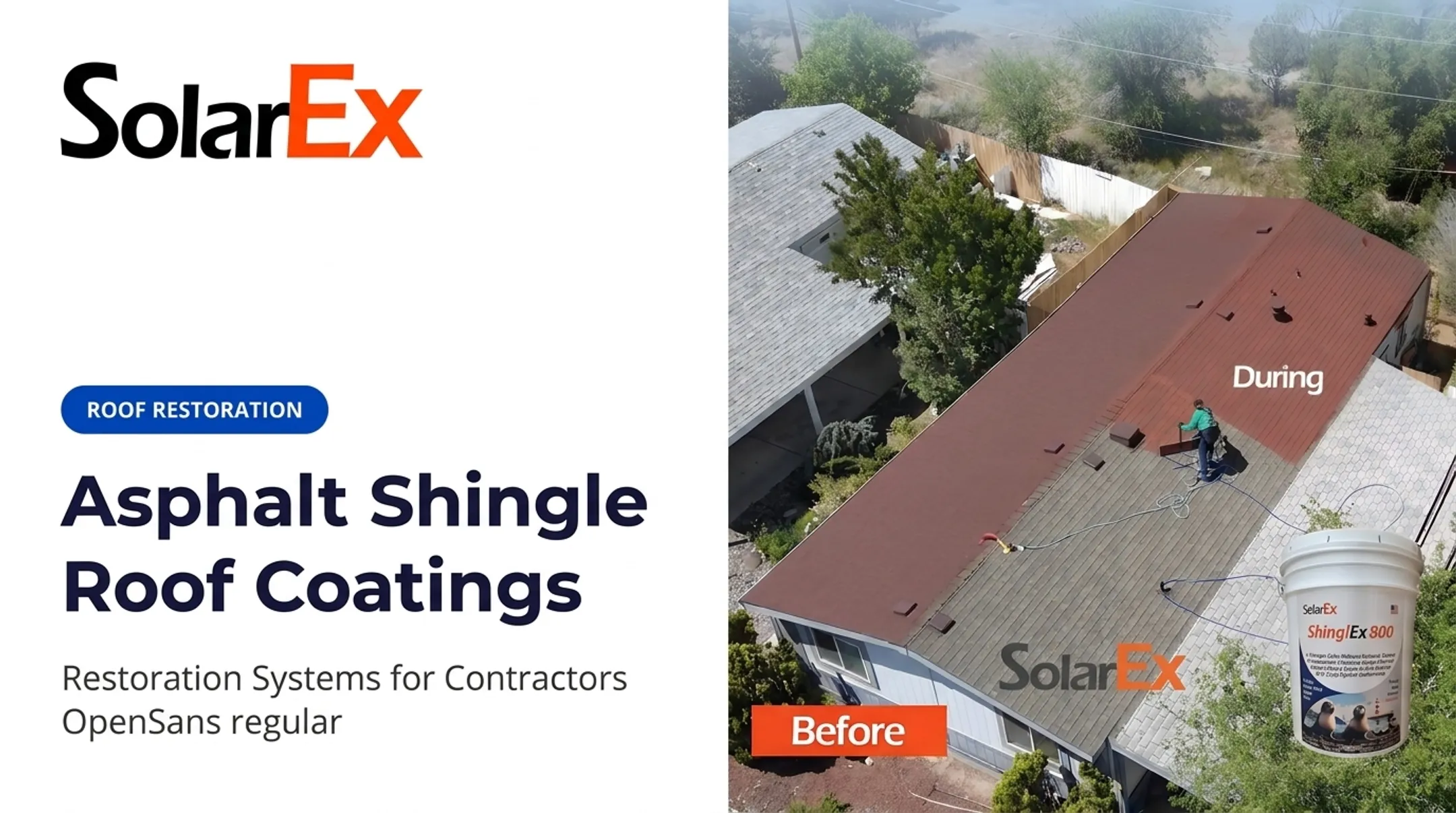
As a real-world reference point, SolarEx's ShinglEx 800 rejuvenator is applied to a clean, dry roof under controlled conditions:
- Surface temperature at least 50°F and rising
- No rain or freezing forecast for 24–48 hours
- About 175–225 sq. ft. per gallon per coat
- Two-coat systems averaging roughly 100 sq. ft. per gallon combined

Professional application reduces risk through controlled coverage, safe access, correct weather timing, and documentation that supports warranty compliance. If you're weighing DIY, don't proceed if:
- The product lacks clear asphalt-shingle instructions
- The roof has active or unexplained leaks
- The surface is fragile or brittle
- The roof is steep or hard to access safely
- Warranty or code implications are unclear
After application, plan for:
- Full curing time before traffic or follow-on work
- A post-cure inspection
- Ongoing maintenance
- A clear read of what the warranty does and does not cover
Cost, Lifespan, and Alternatives
There's no single price tag for shingle roof coating. Cost depends on roof area, pitch and access difficulty, prep work, repairs needed, product type, number of coats, labor, and warranty coverage.
As a rough market reference, broader roof-coating pricing (not asphalt-shingle-specific) has ranged from $543 to $2,528 typical project cost, or roughly $2-$5 per square foot, according to HomeAdvisor's cost data. Treat that as general context, not a quote. Get a written, inspection-based estimate for your specific roof.
For material-only reference, current SolarEx list pricing includes:
- ShinglEx 800 rejuvenator: $299 per 5-gallon pail; $2,690 per 55-gallon drum
- SolarEx 300 acrylic reflective coating: $289 per 5-gallon pail; $2,290 per 55-gallon drum
Materials are only one line item. Labor, prep, and repairs add to the total.
Price only makes sense next to realistic service life—and coating life is not the same as shingle life.
Separating Coating Life From Shingle Life
Don't confuse a product's expected service interval with how much life is left in your shingles. A coating that's rated for a certain number of years doesn't reset the clock on shingles that are already 20 years old and brittle underneath.
The National Roofing Contractors Association notes that most new roofs are designed for about 20 years of useful service. Any specific coating-life number should come from that product's own manufacturer documentation, not a generic industry figure.

Comparing Your Options
| Option | Best For | Key Trade-off |
|---|---|---|
| Targeted repair | Isolated damage on an otherwise sound roof | Doesn't address roof-wide aging |
| Approved rejuvenation | Aging, structurally sound shingles with no active leaks | Not a leak fix; needs the right product |
| Overlay/reroofing | Moderate wear where code permits | Adds weight; can hide problems |
| Full tear-off and replacement | Widespread damage or structural issues | Highest upfront cost; longest-term fix |
The right choice depends on roof condition, not just sticker price.
The "Roofing Over" Question
Installing new shingles or a coating over existing ones without a tear-off can look cheaper on paper. It still carries code, weight, ventilation, inspection, and future-removal implications.
The 2018 International Residential Code restricts roof recover to specific listed conditions and bars it on roofs that are water-soaked, deteriorated, or already carrying two or more layers of roofing. Check local code requirements before treating recover as a shortcut.
How SolarEx Fits the Evaluation
SolarEx approaches roof coatings as one piece of a broader energy-efficiency picture: reflective coatings evaluated alongside solar generation as part of a home or building's overall heat and energy strategy. Not every asphalt-shingle roof qualifies for a coating; the eligibility checks above still apply first.
The company's cool-roof positioning focuses on reducing heat absorption through low-VOC, water-based formulations. SolarEx's shingle coating is stated to reflect up to 85% of solar radiation, and the broader SolarEx Cool Roof line is stated to reflect up to 88%. Any specific reflectivity, durability, or warranty figure should be confirmed against current technical documentation for the exact product and application.
For homeowners and residential roofers, SolarEx's ShinglEx 800 is built as a rejuvenator for asphalt-shingle roofs showing early to moderate aging (granule loosening, color fading) while the shingles remain structurally sound.
ShinglEx 800 fits when:
- Shingles show early to moderate aging but stay structurally sound
- The goal is rejuvenation and sealing, not leak repair
- A roof inspection has confirmed manufacturer and code requirements
Skip it where shingles are already brittle, cracked, curling, or missing. Inspection should come before application, not after.
If you're weighing coating versus repair or replacement, settle that before you spend money either way. Contact SolarEx at +1 (877) 888-2278 or info@solarexsys.com to discuss product compatibility, specifications, and where a coating fits (or doesn't) into your roof's situation.
Frequently Asked Questions
How much does spray-on roof coating for asphalt shingles cost?
Cost depends on roof size, access, prep work, repairs, product choice, labor, and warranty terms. Ask for a written estimate from an on-site inspection, not a generic per-square-foot rate.
Can I put roof coating over shingles?
Some products are formulated for specific shingle applications, but you must confirm compatibility with both the shingle and coating manufacturers first. Check local code requirements and the roof's actual condition too.
Do roof coatings work on asphalt shingles?
Approved, compatible products can work on structurally sound shingles that meet manufacturer requirements. Coatings can't fix structural damage, failed flashing, or severely deteriorated shingles. Those need repair or replacement.
How long does asphalt roof coating last?
Longevity hinges on the product, application quality, climate, shingle condition, and maintenance. Use that coating's manufacturer service life and warranty—not a generic industry average.
What is the best roof coating for asphalt shingles?
There's no single "best" product. Choose based on documented shingle compatibility, the performance you need, warranty terms, local climate, and whether the manufacturer requires professional application.
Is it cheaper to roof over existing shingles?
An overlay may cost less upfront where code permits it, but it can hide underlying problems and raises weight, ventilation, warranty, and future-removal concerns. Compare it against repair, rejuvenation, and full tear-off before deciding.