
Waterproofing blocks moisture. Heat insulation and reflective roofing reduce heat transfer. A roof system that only solves one of these problems is still exposed on the other side, and mixing incompatible materials can create new issues, including trapped moisture under a coating that was supposed to help.
This guide walks through what these terms actually mean, how they interact, how to choose the right system for your roof, how proper application works, and when it's time to call in a roofing professional instead of guessing.
Key Takeaways
- Waterproofing and heat insulation solve different problems; some reflective coatings can address both.
- Match the system to roof type, slope, drainage, and existing condition.
- Service life hinges on surface prep, coating thickness, and curing conditions.
- Reflective coatings cut heat absorption but don't replace code-required insulation or ventilation.
What Roof Waterproofing and Heat Insulation Mean
Roof Waterproofing Explained
Waterproofing is a continuous barrier that stops liquid water from passing through the roof surface. The National Roofing Contractors Association (NRCA) defines a waterproofing membrane by its core job: excluding water, including under hydrostatic pressure.
That barrier has to cover more than the flat field of the roof — seams, flashings, penetrations, and transition points are usually where leaks actually start.
Heat Insulation vs. Reflective Surfaces
These two terms get used interchangeably, but they're mechanically different:
- Bulk insulation slows conductive and convective heat flow through cavity materials or rigid foam, according to the Department of Energy.
- Reflective surfaces bounce radiant heat away before it ever enters the roof assembly.
A cool roof coating falls into the reflective category. ENERGY STAR notes that a clean white roof reflecting 80% of sunlight runs about 50°F cooler on a summer afternoon than a gray roof reflecting only 20%. That's a surface-temperature difference, not proof that a coating replaces insulation underneath.

How Roof Problems Compound Each Other
Leaks, ponding water, UV exposure, and thermal cycling rarely act alone. A membrane that's already brittle from sun exposure cracks faster under thermal expansion. Ponding water sitting on a weak spot accelerates that crack into a leak.
NRCA research shows that higher roof temperatures increase blister pressure, and repeated heating and cooling forces air in and out through existing fissures in the membrane.
A reflective coating can lower peak surface heat, but you still need to assess the insulation, air sealing, ventilation, and overall building envelope before calling the problem solved.
How Waterproofing and Heat Insulation Work Together
The Combined Benefit
A well-designed roof system handles waterproofing and heat control in the same assembly:
- Keeps water out at seams, flashings, and the field membrane
- Reduces heat absorption at the roof surface
- Improves interior comfort in hot weather
- Shields roofing materials underneath from UV degradation
According to the EPA, cool roofs can lower peak indoor temperatures by 2.2–5.9°F (1.2–3.3°C) in non-air-conditioned homes. In cold climates, the same reflectivity can slightly raise winter heating demand if insulation and sun exposure are poor.

Thermal Movement Puts Stress on Seams and Flashings
Roofs expand and contract every day. That movement loads seams, flashings, and penetrations—the same points where waterproofing usually fails first.
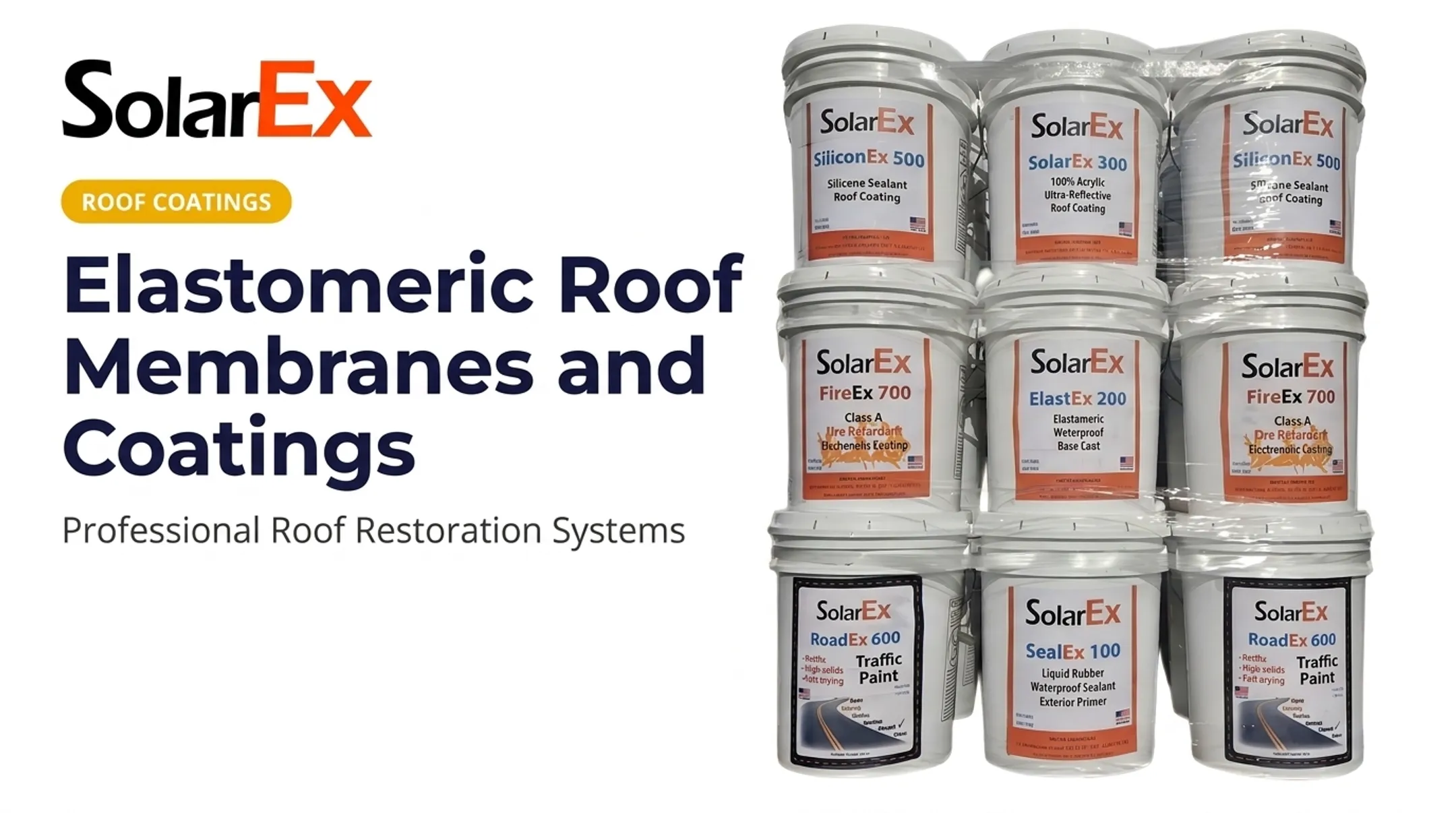
Flexible, weather-resistant coatings can handle that movement when they bond cleanly to the substrate. SolarEx's ElastEx 200, for example, is built as a flexible membrane that bridges small cracks instead of cracking with them.
Moisture Risks a Coating Can't Fix
This is the part people skip. Applying a coating over unresolved moisture problems doesn't solve them — it hides them. Watch for:
- Trapped water beneath an existing coating layer
- Saturated insulation that has already lost its thermal value
- Blocked drains causing repeated ponding
- Blistering from moisture and solvent vapor pockets
NRCA guidance is direct: installing a new roofing system over wet insulation usually fails early. Wet insulation loses thermal resistance and structural integrity. No coating chemistry changes that math.
Part of a Bigger Energy Picture
Once moisture is under control, reflectivity becomes an energy decision, not just a comfort upgrade.
A cool roof coating does not have to be the finish line. SolarEx treats reflective, solar-ready roof coatings as the heat-reduction layer in a broader efficiency plan. Cutting heat gain at the roof surface lowers cooling load first, which makes any later rooftop energy upgrades work harder for the same spend.
What a Coating Won't Do
Be clear about the limits. A roof coating will not:
- Repair structural defects
- Replace damaged decking
- Correct inadequate slope
- Replace installed thermal insulation
It is a protective layer on a roof assembly that still has to be sound underneath.
Choosing the Right Roof Waterproofing and Heat-Insulation System
Start With an Honest Assessment
Before comparing products, look at the roof itself:
- Age and substrate — What's the roof made of, and how old is it?
- Slope and drainage — Does water actually leave the roof, or collect on it?
- Existing membrane condition — Cracked, chalking, blistered, or sound?
- Leak history and penetrations — Where has water gotten in before?
- Foot traffic and ponding — Is this a maintenance-heavy roof or a quiet one?
The Asphalt Roofing Manufacturers Association defines ponding as water remaining on a roof for 48 hours or longer. Beyond damaging the membrane, it can add deck load, reduce insulation efficiency, and accelerate deterioration. A slope problem doesn't get fixed by a coating. Correct drainage first.
Comparing System Categories
| System | Strengths | Watch For |
|---|---|---|
| Silicone (liquid-applied) | Ponding-water resistant, UV-stable, flexible | Slippery when wet; needs proper substrate prep |
| Acrylic elastomeric | Economical, easy application and cleanup | Degrades under continuous standing water |
| EPDM | Durable thermoset sheet | Often needs a wash-primer before coating |
| TPO / PVC | Heat-welded, strong seams | Smooth surface is a real adhesion challenge |
| Modified bitumen | Multi-layer, flexible | Should age 90+ days before acrylic coating |
Silicone vs. Acrylic: The Honest Comparison
Neither material wins in every category:
- Silicone — Better ponding-water tolerance and long-term UV stability
- Acrylic — Lower cost, easier application and cleanup; can chalk under continuous heat and should not sit under standing water
Manufacturer data sheets and substrate approvals should have the final word, not a generic ranking.
SolarEx SiliconEx 500 as a Working Example
SiliconEx 500 is a 100% silicone, solvent-free, moisture-cured coating. It is built as a cool-roof and waterproofing system in one. According to SolarEx product documentation:
- Solar reflectance of 0.87 and thermal emittance of 0.90, giving an SRI of 110
- Designed for permanent ponding-water resistance once fully cured
- Compatible with metal, concrete, wood, TPO, EPDM, and modified-bitumen substrates
- Applied at 2–3 gallons per square with a minimum 32-mil dry film thickness
- Not recommended over structurally failed roofs, wet insulation, or below-grade applications
This is one example of product-to-condition fit, not a universal answer. Final selection still depends on manufacturer instructions, local building codes, and a qualified roofing professional's judgment on the specific roof.
How Roof Waterproofing and Heat-Insulation Coatings Are Applied
Inspection and Diagnosis Come First
Before any coating goes down, the crew should map active leaks, wet insulation, damaged decking, failed flashing, open seams, blisters, and problem drains. Skipping this step is the single most common reason coatings fail early.
Surface Preparation Determines Adhesion
Coatings bond only to the surface underneath them. Preparation typically includes:
- Pressure washing at 2,500–3,000 psi to remove dirt, algae, and chalking film
- Treating biological growth and removing loose or degraded material
- Confirming substrate dryness (concrete moisture content generally below 5%)
- Applying primer where the substrate calls for it
Primer selection isn't one-size-fits-all:
- Rusted metal often needs a rust-inhibitive primer
- Modified bitumen and BUR usually need a bleed-blocking primer to stop asphalt staining through the topcoat
- Porous concrete may need a bonding primer
SolarEx's BleedEx 400 and PrimEx 505 cover the bleed-blocking and bonding cases. Run an adhesion test whenever compatibility is uncertain.
Detailing Before the Broad Coat
Seams, laps, fasteners, flashings, HVAC penetrations, curbs, drains, and parapet transitions get reinforced before the field application starts. Joints and cracks are typically sealed first, and repaired areas usually get two pre-coats extending at least 2 inches beyond the repair edge.

Application and Quality Control
Getting the thickness right matters more than most people expect:
- Apply within the manufacturer's specified rate per coat (SiliconEx 500 shouldn't exceed 1.5 gallons per 100 square feet per pass)
- Work within recommended weather windows (for SiliconEx 500: 40°F–120°F, humidity below 70%, and no rain)
- Allow the specified recoat window, generally 6–24 hours between coats
- Check applied thickness with a wet-mil gauge rather than eyeballing it
- Confirm drainage is working before calling the job finished
A Quick Word on Safety
Roof work carries real fall risk. OSHA's fall protection standards (29 CFR 1926 Subpart M) require guardrails, safety nets, or personal fall-arrest systems on most low-slope roofing work. Steep, wet, fragile, or contaminated surfaces are not a DIY weekend project; use qualified applicators and proper PPE.
Maintaining the System
A coating isn't a "set it and forget it" upgrade. Watch for these warning signs:
- Recurring leaks or ceiling/wall stains
- Bubbling, blistering, cracking, or peeling
- Exposed substrate or loose flashing
- Blocked drains or persistent ponding
- Unusually hot interior spaces during peak sun
Build a simple routine:
- Inspect visually twice a year (spring and fall, matching NRCA's recommended schedule)
- Clear drains and gutters
- Remove debris after storms
- Repair small defects promptly with compatible materials before they spread
Service life isn't universal. It depends on the product, application quality, climate exposure, roof traffic, and how consistently you maintain the system. A well-installed silicone coating is often built around a 10-, 15-, or 20-year warranty window. That figure comes from documented product specs, not a blanket promise for every roof.
Frequently Asked Questions
What is the best way to waterproof your roof?
There isn't one universal method. The right approach depends on your roof's material, slope, drainage, condition, and leak history. A professional assessment and manufacturer-compatible materials are the safest starting point.
Does roof waterproofing reduce heat?
Standard waterproofing alone doesn't meaningfully cut heat. Reflective waterproofing coatings can lower surface temperature, though the energy benefit still depends on your roof assembly, climate, and building.
Is roof coating the same as roof insulation?
No. A coating reflects solar radiation and reduces heat absorption at the surface. Insulation reduces heat flow through the roof assembly itself. They're related but serve different functions.
Can every roof be waterproofed with a coating?
Not every roof qualifies. Coatings can fail over saturated insulation, severe structural damage, incompatible substrates, or poor drainage that hasn't been corrected first.
How long does roof waterproofing last?
Service life varies by material, application quality, weather exposure, and maintenance. Documented ranges run roughly 10–20 years for silicone systems, but always check the specific product and warranty documentation.
Can one system waterproof a roof and reduce heat?
Yes. Reflective waterproof coatings seal against moisture while bouncing back solar radiation at the surface. They are not a substitute for batt or board insulation, but they can cut heat gain and protect the roof in one application.