
Introduction
Water doesn't need a big opening to cause damage. A quarter-inch gap around a vent pipe, a cracked seam on a flat commercial roof, or a curled shingle edge can let moisture into a building for months before anyone notices a stain on the ceiling.
Add in UV exposure, freeze-thaw cycles, and constant roof expansion and contraction, and it's easy to see why sealant failure is one of the most common causes of leaks in US buildings.
Two products get lumped together but do different jobs. A roof sealant is spot-applied — think seams, cracks, flashing, and penetrations. A roof coating covers the entire surface with a protective membrane.
This guide breaks down the main sealant chemistries, where each one fits, and how to choose the right product for the job. Sealant is not a substitute for structural repair — and this guide marks exactly where that line sits.
Key Takeaways
- The right sealant depends on roofing material, ponding water, movement, and climate exposure — not brand reputation
- Match chemistry to conditions: silicone for ponding and UV, polyurethane for impact and movement, acrylic for dry reflective repairs, bitumen for asphalt
- Roofs must be clean, dry, and structurally sound before any sealant goes on. Manufacturer instructions always take priority.
- Full-surface coatings often outperform caulk-style sealants when the goal is broad waterproofing or heat reduction
Overview of Roof Sealing in the US Roofing Market
Roof sealing means applying a compatible waterproof material to close specific vulnerable points: seams, joints, cracks, fastener penetrations, and flashing transitions. It's targeted work, not a whole-roof solution.
A roof coating is different. The National Roofing Contractors Association (NRCA) defines a roof coating as a "fluid-applied, adhered coating" used for maintenance, repair, or as part of the roof assembly itself. NRCA also flags that not every coating product meets building-code or fire-classification requirements, so verify testing listings before you buy.
Common US roof systems and why chemistry matters:
- Asphalt shingles — need UV-stable, flexible products that won't strip granules
- Metal roofing — requires rust-inhibitive primers and sealants that move with thermal expansion
- Modified bitumen and built-up roofing (BUR) — often needs bitumen-compatible chemistry to avoid bleed-through
- EPDM, TPO, PVC single-ply membranes — each has distinct primer and adhesion requirements
- Concrete decks — moisture content and curing status affect adhesion
Every sealant and coating is judged on the same core traits: adhesion, flexibility, UV resistance, water resistance (including standing water), movement accommodation, and cure behavior in real weather.

The categories below are organized by chemistry and purpose—not ranked best to worst. Always confirm current technical data sheets, warranty terms, and testing data before specifying a product for a real job.
Top Waterproof Roof Sealants for Different Applications
Choosing among silicone, polyurethane, acrylic, and bitumen comes down to seven questions: waterproofing performance, substrate compatibility, flexibility, weather resistance, ease of application, ongoing maintenance, and whether the product actually suits your repair. Each chemistry answers those questions differently.
SolarEx Silicone Roof Coating or Sealant System
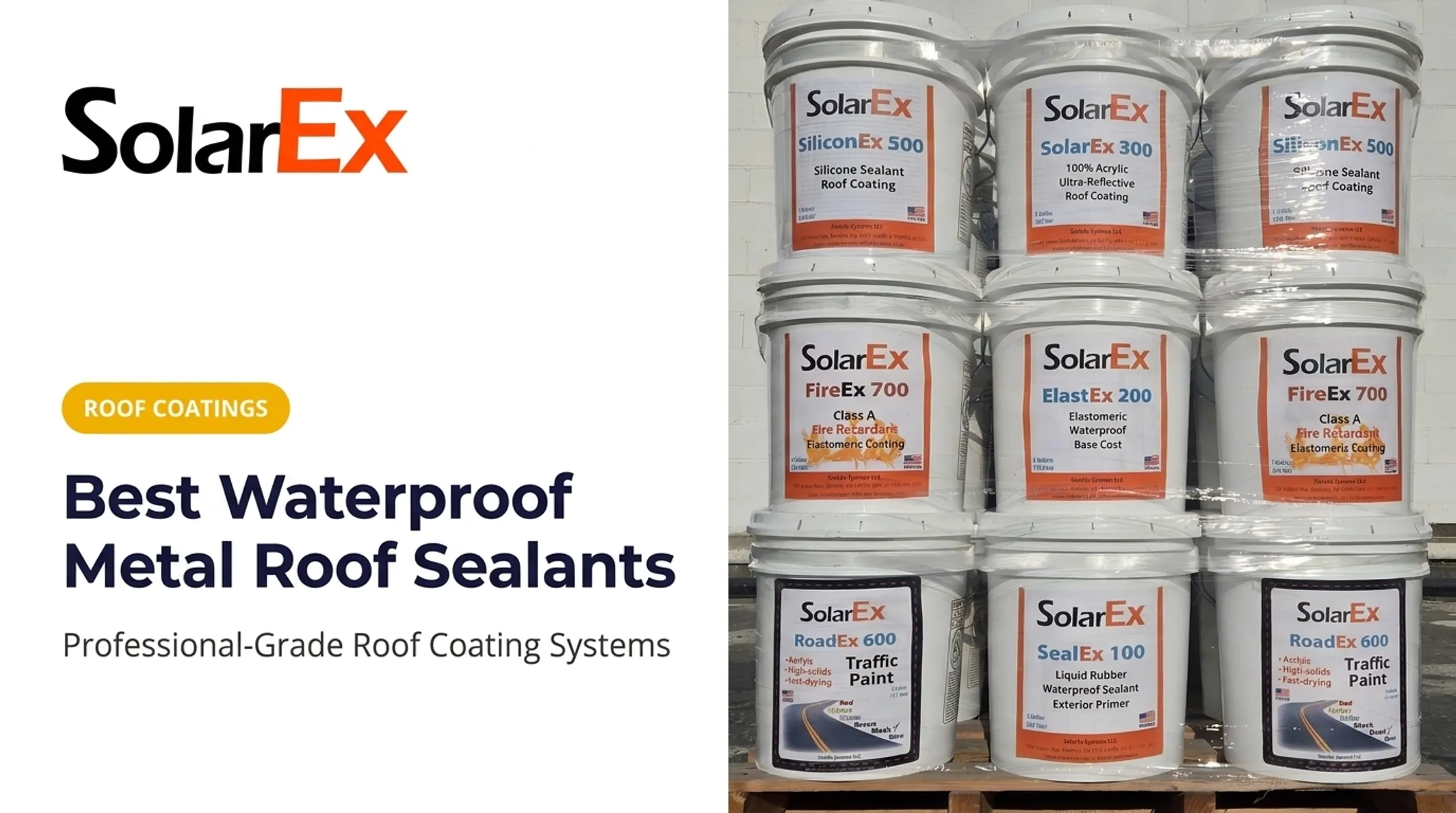
SolarEx's SiliconEx 500 is a 100% silicone, solvent-free, single-component, moisture-cured coating built for full-surface application rather than isolated patching. Before the field coating goes down, joints, cracks, and extrusions get sealed separately with SealEx 510 Mastic (a 100% silicone sealant) or SealEx Tape. The coating and the detail sealant work as a system, not a single product. Once cured, SiliconEx 500 forms a monolithic, highly elastic membrane that resists softening or re-emulsifying under standing water. That's a meaningful distinction from many acrylic coatings, which aren't rated for persistent ponding. The formulation carries a VOC content of 8 g/L, making it a low-VOC option for projects with strict environmental requirements. At a glance:
| Feature | SiliconEx 500 |
|---|---|
| Compatible substrates | Metal, concrete, wood, TPO, EPDM, single-ply, smooth/granulated membrane |
| Application method | Nap roller, soft brush, or airless spray |
| Ponding-water suitability | Resists softening under standing water once fully cured |
| Cure time | Tack-free in 70–80 minutes; full cure in 12–24 hours |
| Reflectivity | Initial reflectivity of 87%, dropping to roughly 72% after three years of aging |
| Warranty | Up to 20-year material warranty depending on system specification |
| Professional install recommended | Yes — labeled for professional use only |
| Minimum recommended dry-film thickness is 22 mils, with textured surfaces sometimes needing extra coats to hit 30 mils. Confirm exact figures against the current SiliconEx 500 technical data sheet before quoting a job. |
Silicone Roof Sealants
Beyond single-product systems, silicone as a category earns its reputation on low-slope roofs and anywhere standing water collects. It resists UV degradation and prolonged moisture better than most other chemistries, which is why manufacturers like CSL Silicones and GAF formulate coatings specifically rated for permanent ponding water. GAF's Unisil silicone coating data sheet states the roof must have positive drainage and be completely clean and dry, with no trapped moisture, before application. That caveat matters: trapped moisture under a silicone membrane will eventually cause blistering. Limitations worth knowing:
- Contaminated substrates (dirt, chalking paint, old caulk, grease) cause adhesion failures; CSL requires power washing and an adhesion-test patch first
- Some silicone formulations resist standard paint, so later color changes can be tricky
- Active leaks and substrate damage need repair before sealing, not after
Performance profile:
Factor Typical performance Ponding-water resistance Strong — often rated for permanent ponding Movement capacity High elasticity, good for expansion/contraction Surface prep Power wash, remove contaminants, adhesion test Primer requirement Often not required, but varies by substrate Maintenance Recoating requires silicone-compatible products
Polyurethane Roof Sealants
Polyurethane earns its place around flashing, chimney details, shingle tabbing, and nail covering — anywhere joints move and need strong adhesion to hold. Loctite's PL Roof and Flashing sealant, for example, lists +/-35% movement capability and reports resistance to corrosion, tearing, UV, and ozone. One-component formulations skip mixing and suit small repairs. Two-component versions, like pitch-pocket fillers used in some membrane systems, handle larger pours where curing speed and depth matter more. Polyurethane tends to beat silicone where abrasion and foot traffic are the concern — service paths near HVAC units or roof-access points, for instance. Performance still varies a lot by formulation, so don't assume every polyurethane product behaves the same way. Key specs:
| Factor | Typical performance |
|---|---|
| Adhesion | Strong, especially on joints and flashing |
| Elasticity | Good; some products rated to ±35% movement |
| Application temperature | Roughly 40°F to 90°F, best at 60–90°F |
| Moisture during cure | Adversely affects adhesion — surface must be dry |
| Substrate exclusions | Not for permanent immersion, some plastics, or torched modified-bitumen membranes |
Acrylic Roof Sealants and Coatings
Acrylic products are usually water-based, UV-resistant, and budget-friendly. That mix makes them popular for reflective roof restoration on properly draining metal and asphalt roofs. The ASTM D6083 specification for liquid-applied acrylic latex elastomeric roof coatings covers elongation, tensile strength, and low-temperature flexibility. Application guidance sits outside the spec, so you still need the manufacturer's instructions. There's a real difference between acrylic caulk-style sealants (used for cracks and small repairs, applied by brush or trowel) and acrylic roof coatings (applied over a full base coat as a reflective top layer). Mixing up the two leads to underperforming repairs. Standing water is the catch. Most acrylic products aren't rated for persistent ponding unless specifically labeled for it. Some technical sheets explicitly exclude areas with inadequate drainage. Typical profile:
| Factor | Typical performance |
|---|---|
| Suitable climates | Most US climates with adequate drainage |
| Water exposure | Not ideal for persistent ponding water |
| Reflectivity | High — often used for cool-roof restoration |
| VOC considerations | Generally low, water-based |
| Application conditions | Requires dry surface, suitable temperature window |
Bituminous or Asphalt-Based Roof Sealants
Bitumen-based sealants make sense where the existing roof is already asphaltic: modified-bitumen membranes, BUR systems, and flashing repairs on shingle roofs. Compatibility with the existing material is the whole point; bituminous chemistry bonds where silicone or acrylic might not. The trade-offs are real: solvent odor, black tar-like appearance, and temperature sensitivity during application all matter. The Asphalt Roofing Manufacturers Association's cold-weather bulletin notes that cold temperatures stiffen sheet materials and slow curing, which affects timing on modified-bitumen jobs. Some solvent-based products also carry flammability warnings and need ventilation during application. Quick reference:
| Factor | Typical performance |
|---|---|
| Substrate compatibility | Asphaltic, modified-bitumen, shingle flashing |
| Wet-weather limitations | Application typically requires dry conditions |
| UV performance | Generally weaker than silicone without a top coat |
| Application temperature | Sensitive to cold — check product minimums |
| Maintenance | Recoat as surface chalks or cracks |

How We Chose the Best Roof Sealants
We ranked sealants by how well they match real roof conditions—not catalog claims. Product selection starts on the roof, not in a brochure. Before choosing a chemistry, walk the surface and answer these questions:
- Where's the leak path? Seam, penetration, flashing defect, crack, or widespread membrane failure — each points to a different fix
- Is there rot or loose material? Sealant over a compromised deck just hides the problem temporarily
- Does water pond anywhere? Check after rain, not just on a dry day
- Is drainage adequate? Poor slope will keep causing failures no matter what product you use
From there, match product chemistry to roof condition using the manufacturer's documentation: substrate approvals, ponding-water rating, movement capability, climate suitability, and cure requirements. A "waterproof" label alone does not prove the product fits your roof.

What to compare in the paperwork:
- Technical data sheets and safety data sheets
- Warranty exclusions (many exclude misuse or incorrect application)
- Coverage rates and minimum dry-film thickness
- Primer instructions by substrate
- Recoat windows and VOC content
Common mistakes that void warranties and cause failures:
- Applying over damp, dirty, or contaminated surfaces
- Sealing over active structural damage instead of repairing it
- Mixing incompatible chemistries (silicone over acrylic, for example)
- Ignoring old, failed caulk instead of removing it
- Working outside the product's stated temperature range
- Assuming sealant replaces proper drainage correction or roof replacement
A deteriorated deck, widely saturated insulation, or membrane failure spread across large sections of roof usually means replacement — not another coat of sealant.
Safety matters here too. OSHA requires fall protection for workers on roofs six feet or more above lower levels with unprotected edges. Factor in weather, ventilation for solvent-based products, and proper protective equipment.
If the roof is steep, large, or shows structural trouble, call a qualified roofing professional instead of tackling it solo.
Conclusion
The best waterproof roof sealant matches your roof material, leak location, movement demands, water exposure, and climate. Apply it exactly as the manufacturer specifies.
Choose the format that fits the job:
- Spot sealants for localized joints and penetrations
- Full-surface coatings for broader moisture protection or restoration
- Reflective coating systems when cooling-cost reduction matters
Before buying, inspect the roof condition and read the product documentation completely.
If you're weighing cool-roof coatings for long-term energy efficiency, SolarEx can walk through product fit and project scope. Reach out at +1 (877) 888-2278 or info@solarexsys.com for guidance, without assuming service availability in every location.
Frequently Asked Questions
What is the best sealant for a roof?
Match the sealant to roof material, repair location, ponding exposure, and joint movement. Silicone handles standing water and UV; polyurethane suits high-movement joints; acrylic fits dry reflective repairs; bitumen pairs with asphaltic systems.
What is the best way to seal a roof?
Inspect first, repair any underlying damage, then clean and dry the surface completely. Test product compatibility, apply per the manufacturer's instructions, let it cure fully, and inspect again. Larger or unsafe repairs call for a roofing professional.
What time of year is best to seal a roof?
Follow the product data sheet for temperature, moisture, and rain windows. Most roof sealants need a dry surface and mild conditions so the material can cure fully before weather hits.
How often should a roof be sealed?
Frequency depends on the roof system, sealant chemistry, weather exposure, and installation quality. There's no universal schedule. Inspect regularly for cracking, peeling, loss of adhesion, or new leaks, and reseal based on what you find.
Is sealing your roof a good idea?
Yes, when the roof is structurally sound and the sealant is compatible. It extends service life and stops localized leaks. It won't fix widespread deterioration, structural damage, poor drainage, or a roof that genuinely needs replacement.